Chidinma got the job offer on a Tuesday. Australian company, remote first role, relocation package included. She told her mum that weekend. She told her landlord she wouldn’t be renewing the lease. Then she waited. And waited. Four months later, she was still refreshing her email, watching her start date get pushed back three times, wondering if she had made a huge mistake telling everyone before the visa was actually in hand.
This is the part nobody warns you about. Getting the job offer is the finish line in your head. In reality, it is the starting gun for a second race, the visa race and that race has different rules depending on which country you are running it in.
So let’s actually break this down, country by country, with real numbers instead of “it varies.”
Why Visa Sponsorship Timelines Are So Unpredictable
Before the breakdown, you need to understand what actually eats up the time. Sponsorship is not one step, it is usually three or four stacked on top of each other:
- Labor market checks (does the government need to confirm no local worker could do this job?)
- The actual visa/petition processing (the government reviewing your file)
- Biometrics and medical exams (booking appointments, waiting for slots)
- Embassy or consulate scheduling (which can add weeks on its own, especially from Lagos, Nairobi, Accra, or Harare where appointment slots fill up fast)
Two people applying for the same visa can have wildly different timelines depending on which of these steps their country requires and how backed up their local visa center is.
Country-by-Country Breakdown
🇺🇸 United States (H-1B and Employment-Based Green Cards)
The H-1B is the one everyone asks about, and it’s also the one with the most moving parts.
- Registration happens once a year, typically in March, through a lottery system you can not just apply whenever you want.
- Once selected, standard processing of the petition currently runs about 9 to 10.5 months for most H-1B petitions as of mid-2026.
- Employers can pay for premium processing, which guarantees a decision within 15 business days for a fee that increased to $2,965 in March 2026.
- If your employer is chasing a green card for you afterward, brace yourself: per country caps mean Nigerian, Kenyan, Ghanaian, and Zimbabwean applicants generally fall into the “Rest of World” category , which as of the March 2026 Visa Bulletin faced roughly a 1.5-year wait for EB-2 final action far better than the multi decade backlogs facing applicants from India or China, but still not instant.
Bottom line: budget 9–11 months for the work visa itself, and know the green card is a separate, slower journey.
🇬🇧 United Kingdom (Skilled Worker Visa)
This is usually the fastest of the major destinations, which is part of why it is so popular with African applicants.
- Applying from outside the UK, standard processing is up to 3 weeks from when you submit your biometrics at a visa application centre.
- Priority processing can bring that down to as little as 5 to 10 working days , depending on the visa centre.
- Switching or extending from inside the UK takes longer standard applications there run 3 to 8 weeks (Sponsor Companies) , with priority services cutting that to 5 working days.
Bottom line: once your Certificate of Sponsorship (CoS) is issued, the actual visa decision is often the quickest part of the whole process.
🇨🇦 Canada (Employer-Sponsored Work Permits)
Canada is the one where people underestimate the total timeline because they only count the work permit, not the LMIA that comes before it.
- If your employer needs a Labour Market Impact Assessment first, that alone typically takes 4 to 8 weeks for standard applications.
- After the LMIA is approved, applying for the work permit from outside Canada currently runs around 21 weeks (about 5 months) on average, though this varies a lot by country.
- Applicants from Nigeria specifically have recently seen improvements, with processing times dropping roughly 6 weeks faster in recent updates but “faster” here is relative to a system that was already slow.
- If your employer qualifies for the Global Talent Stream (common in tech), things move much quicker LMIA approval there can land in around 10 business days.
Bottom line: if there’s an LMIA involved, plan for 5–7 months total, not weeks.
🇩🇪 Germany (Work Visa / EU Blue Card)
Germany has quietly become one of the more realistic options for African skilled workers, especially in IT, engineering, and healthcare.
- Standard work visas, including the EU Blue Card, are currently taking 6 to 12 weeks from submission at the German embassy or consulate.
- Germany’s new digital application portal has pushed some cases down to 4 to 6 weeks, compared to 8 to 12 weeks previously.
- If your role needs approval from the Federal Employment Agency, that can add another 2 to 4 months on top.
Appointment booking itself can be its own bottleneck, wait times for an embassy appointment can stretch from 2–3 weeks in parts of Europe to as long as 6–12 months in parts of Asia, so don’t assume the appointment is instant just because the processing is fast.
Bottom line: 6–12 weeks for the visa decision itself, but always check appointment availability separately.
🇦🇪 United Arab Emirates (Employment Visa)
The Gulf is often the fastest route into a paycheck, which is why so many Nigerians, Kenyans, and Ghanaians use it as a stepping stone.
- End-to-end, from job offer to a fully stamped residence visa, the process typically runs two to four weeks.
- The work permit portion specifically has been sped up under a new government initiative, now issuing in approximately five working days, down from 30.
- Your employer is legally required to cover the visa costs, deducting these fees from your salary is illegal under UAE labor law.
Bottom line: this is the fastest option on this list if speed matters more than long term settlement pathways.
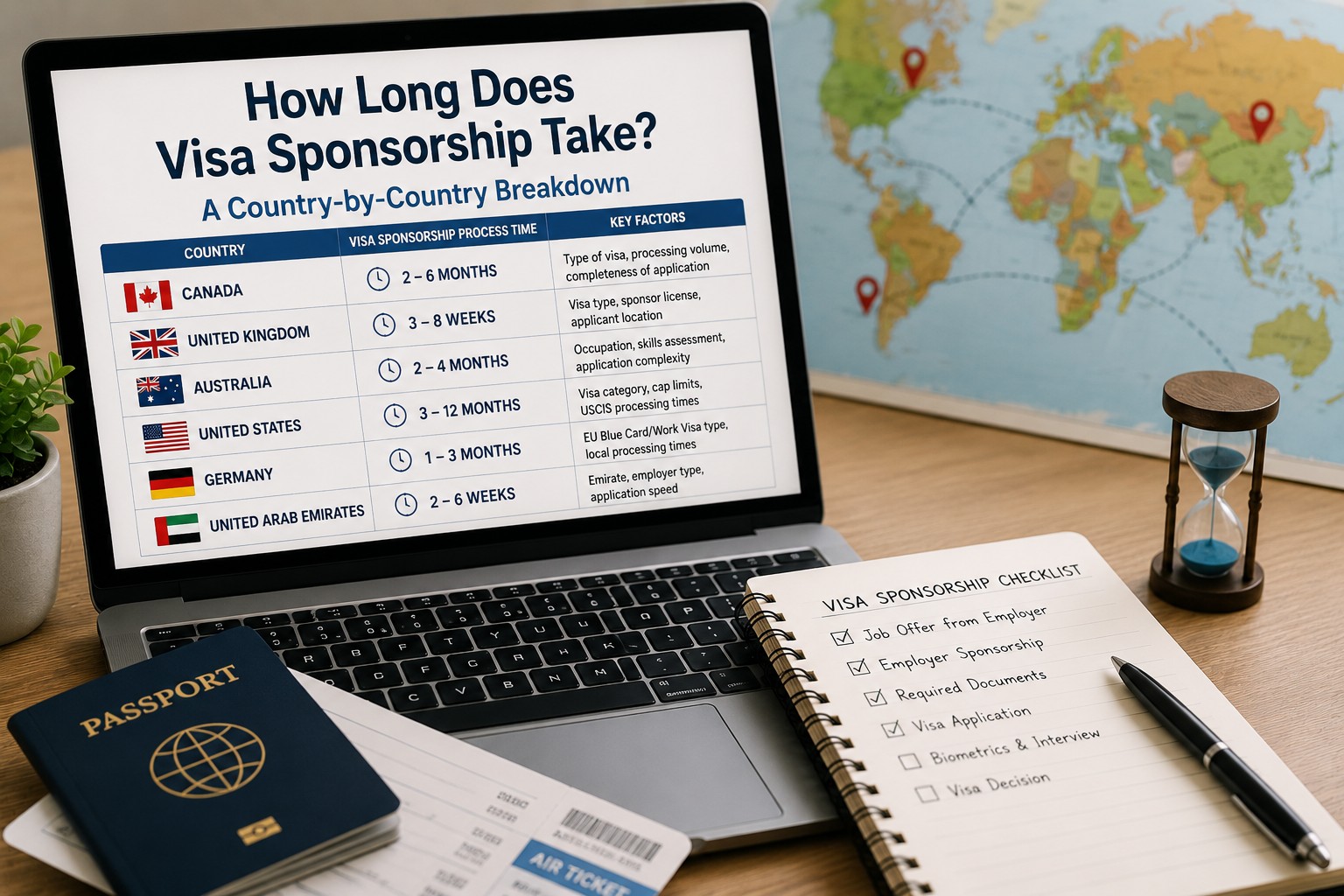
Quick Comparison Table
| Country | Typical Processing Time | Fastest Option Available |
|---|---|---|
| 🇺🇸 United States (H-1B) | 9–10.5 months | Premium Processing: Approximately 15 business days (additional government fee required) |
| 🇬🇧 United Kingdom (Skilled Worker Visa) | 3–8 weeks | Priority Service: 5–10 working days (where available) |
| 🇨🇦 Canada (LMIA-Based Work Permit) | Approximately 5 months (including LMIA processing) | Global Talent Stream: Around 10 business days for eligible employers and occupations |
| 🇩🇪 Germany (Work Visa / EU Blue Card) | 6–12 weeks | Approximately 4–6 weeks through participating digital application portals |
| 🇦🇪 United Arab Emirates (Employment Visa) | 2–4 weeks | Work Permit Stage: As little as 5 working days for eligible applications |
What Actually Slows Down African Applicants Specifically
It is not favoritism, it is logistics, but the effect is the same, so plan around it:
- VFS/VAC appointment scarcity. In Lagos, Nairobi, and Accra especially, biometric appointment slots for UK and Canada visas can be booked out weeks in advance.
- Document authentication delays. Getting degree certificates attested or apostilled locally can add real time that has nothing to do with the embassy itself.
- Additional security screening. Some countries apply enhanced background checks for certain nationalities , which can stretch official timelines noticeably beyond the published average.
None of this means don’t apply. It means build in a buffer instead of quitting your current job the day you get the offer.
Also Read 👉 IELTS Preparation Guide: The Ultimate Roadmap to a Higher Band Score (2026)
FAQ
1. Does visa sponsorship guarantee I will get the visa?
No. Sponsorship means an employer is willing to support your application and has usually started the process on their end. The government still reviews and can refuse your case.
2. Can I speed up any of these timelines myself?
Yes, partially. Submitting a complete, error-free application on the first try is the single biggest thing in your control. Missing documents or an incomplete form is the most common reason a 6 week case turns into a 4 month one.
3. Should I resign from my current job before the visa is approved?
Not until you have the actual approval or visa stamp in hand, or at minimum written confirmation from immigration that your case has cleared final review. Chidinma’s story is not rare.
4. Which of these countries has the fastest realistic path to work abroad?
Based on current processing times, the UAE and UK tend to move quickest for the visa decision itself. The US and Canada are typically the slowest, largely due to caps and pre-approval steps like LMIAs.
5. Do premium or priority processing services actually work?
Where they are offered the US premium processing and UK priority service being the clearest examples yes, they genuinely cut weeks or months down to days. They cost extra, but if a start date is on the line, it is often worth it.
6. Why did my friend’s visa take way longer than the “average” I read online?
Averages are exactly that averages. RFEs (requests for evidence), incomplete documentation, embassy backlogs, and nationality-specific security checks can all push an individual case well past the published estimate.
Now Note:Getting the offer is a win celebrate it. But hold off on the goodbye party until the visa is actually in your passport. I have watched too many people count their chickens at the offer letter stage. Build your timeline around the country’s real numbers, not the hope in your chest, and you will navigate this a lot calmer than Chidinma did.
About the Author:
Henry Mbah, is a career and education writer with Jobsroutedaily specializing in international jobs, scholarships, visa sponsorship opportunities, and career guidance. Passionate about helping readers access reliable information to achieve their education and employment goals.