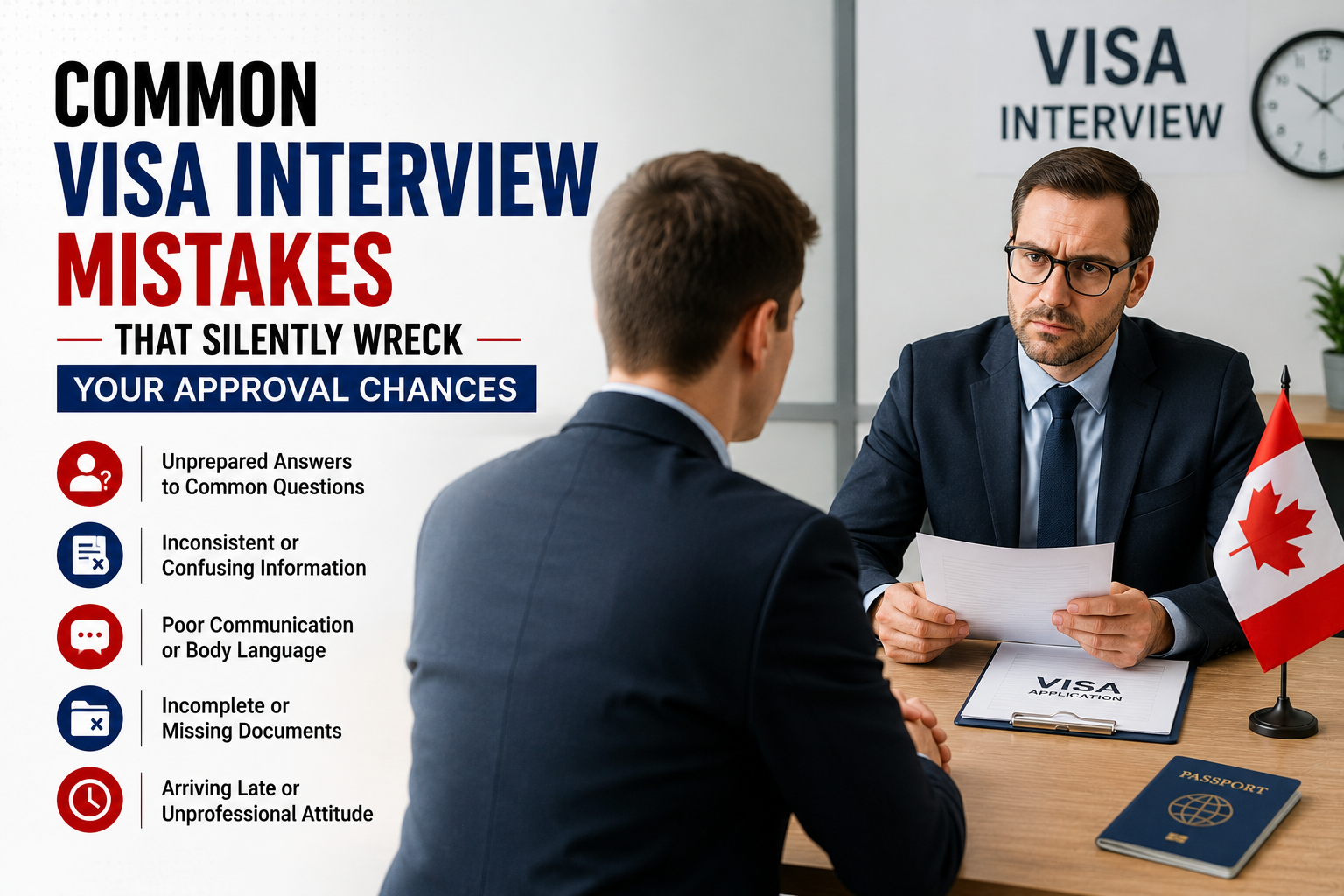
Common Visa Interview Mistakes That Quietly Cost People Their Approval
Imagine this, you have spent weeks gathering documents, filling out forms, and rehearsing your story in front of the mirror. You walk into the consulate feeling ready. Ten minutes later, you are walking back out with a denial slip in your hand, replaying the interview in your head, wondering exactly where it went wrong.
If that scenario makes you uneasy, you are not imagining things, it happens to thousands of applicants every single day, and rarely because their case was hopeless. More often, it comes down to a handful of avoidable visa interview mistakes that quietly chip away at credibility in front of the officer. The frustrating part is that most of these errors have nothing to do with qualifications and everything to do with preparation, tone, and consistency.
In this guide i break down the visa interview mistakes that trip up applicants most often, for tourist, student, and work visas alike and, more importantly, exactly how to avoid making them yourself.
Why Visa Interview Mistakes Matter More Than People Realize
A visa interview usually lasts just a few minutes. Consular officers see dozens of applicants a day, and they have learned to read between the lines fast. As one guide from former U.S. visa officers put it, an interview is really the officer’s chance to confirm you meet the requirements for the visa you’re seeking, and uncertainty about your travel plans, finances, or ties back home is often enough to tip a decision toward denial.
That is the uncomfortable truth: it is rarely one dramatic error that sinks an interview. It is usually a pattern of small visa interview mistakes stacking up a hesitant answer here, a mismatched detail there that adds up to doubt in the officer’s mind.
Mistake #1: Walking In Without Real Preparation
This is, hands down, the most common of all visa interview mistakes, and also the easiest to fix. A lot of applicants assume that submitting the right paperwork is enough, or that they will simply wing it once they are in the room. Neither approach works.
Consular officers can tell within seconds whether someone has thought through their answers or is improvising on the spot. According to one breakdown of frequent errors, walking into an interview without proper preparation sends an immediate signal that you’re not taking the process seriously and that impression is hard to undo once it’s formed.
Here is what real preparation actually looks like:
- Review every answer on your application form (DS-160, DS-260, or the equivalent for your visa type) so nothing you say contradicts what you wrote.
- Practice answering common questions out loud, not just in your head.
- Prepare a clear, honest explanation of your travel purpose, funding, and timeline.
- Know key dates, addresses, and relationship details cold, officers often ask about specifics to test consistency.
Mistake #2: Letting Your Answers Contradict Your Application
This one catches people off guard because it usually is not intentional. You filled out your form months ago, memory fades, and suddenly your spoken answer does not quite match what is written on paper.
The problem is that consular officers work directly off your submitted forms. As one legal team put it plainly, if your verbal answers contradict your written forms, it raises red flags about your credibility , even if the contradiction was a genuine memory slip rather than dishonesty.
How to avoid it:
- Print your submitted application and read through it again the night before your interview.
- Make short notes on key facts dates, employer names, addresses, relationship timelines.
- If you spot an error in your original application, don’t try to hide it. Acknowledge it honestly rather than let the officer discover the inconsistency themselves.
Mistake #3: Being Vague Instead of Specific
Vague answers are a magnet for suspicion. If an officer asks what you plan to study, where you will live, or what your job entails, and you respond with something fuzzy like ‘I haven’t thought about it yet’ it signals a lack of genuine intent, even if your intentions are perfectly real.
This shows up constantly in student visa interviews. One guide focused on F1 visa preparation noted that vague or incorrectly framed answers raise doubts about your intentions to study abroad, and recommended writing down your goals in advance so they align cleanly with what’s already on your application form.
The fix is simple but requires effort:
- Write out your answers to the most likely questions before the interview.
- Replace vague statements with specific, concrete details (“I plan to return home and apply my degree to expanding my family’s business” beats “I’ll figure it out later”).
- Avoid one-word answers, they can come across as evasive, even when you are just nervous.
Mistake #4: Weak or Confusing Financial Documentation
Money questions trip up more applicants than almost anything else. It’s not usually about not having enough funds, it is about failing to present that financial picture clearly and consistently.
Common financial documentation missteps include outdated bank statements, unexplained sponsors, or numbers that don’t line up with your stated income. As one detailed breakdown explains, your financial documentation should tell a coherent story about your economic stability and your ability to fund the trip without relying on unauthorized work abroad.
To sidestep this mistake:
- Bring recent, updated bank statements, not ones from six months ago.
- If someone else is sponsoring your trip, clearly explain the relationship and bring supporting proof.
- Make sure your documents tell one consistent story, not three conflicting ones.
Mistake #5: Dishonesty, Big or Small
This is the one mistake that can follow you for life, not just this application. Consular officers have access to extensive government databases, and inconsistencies get flagged fast.
Here is the part people underestimate: admitting to a past mistake, like a prior overstay or a minor legal issue, might only require a waiver. But lying about it? That can result in a permanent ban for fraud or misrepresentation, as one immigration law firm bluntly warns applicants navigating consular interviews.
A few honesty-related habits worth adopting:
- Never fabricate details to make your case sound stronger, officers are trained to detect invented stories.
- If you’re unsure about an answer, say so rather than guessing. Guessing wrong can look worse than admitting uncertainty.
- Clean up your social media before your interview, since officers may review public profiles, and anything contradicting your application details can raise concern.
Mistake #6: Poor Body Language and Attitude
It is not just what you say it is how you say it. Nervous fidgeting, avoiding eye contact, or coming across as defensive can all work against you, even when your answers are technically correct.
As one travel focused guide summarized well, as a lack of confidence or even dishonesty, while a polite, composed demeanor leaves a much stronger impression, regardless of nerves.
Small adjustments that go a long way:
- Take a breath and pause before answering instead of rushing.
- Maintain natural eye contact and an open posture.
- Stay polite and calm even if a question feels repetitive or uncomfortable defensiveness reads as a red flag.
Mistake #7: Incomplete or Disorganized Documentation
Fumbling through a stack of loose papers looking for the right form does not just waste time, it quietly signals disorganization and, by extension, a lack of seriousness about the process.
One guide focused on U.S. visa appointments recommends bringing every possible document, even ones you are unsure are necessary, because Officers will often ask for paper work you do not expect to need. That includes your appointment letter, valid passport, confirmation page, and any category-specific supporting documents.
A simple pre-interview checklist habit helps enormously:
- Organize documents in the order you’re likely to be asked for them.
- Keep originals and copies separated but easy to access.
- Double-check passport validity — most consulates require it to remain valid well beyond your planned travel dates.
Comparison Table: Visa Interview Mistakes vs. What Officers Actually Want to See
| Interview Mistake | What It Signals to the Officer | What to Do Instead |
|---|---|---|
| Vague Answers About Your Plans | May suggest a lack of genuine intent or preparation. | Provide clear, specific, and well-thought-out details about your study, work, or travel plans. |
| Contradicting Your Written Application | Can raise concerns about honesty or credibility. | Review your application forms thoroughly before the interview to ensure your answers are consistent. |
| Outdated or Unclear Bank Statements | May indicate financial instability or insufficient proof of funds. | Bring recent, complete, and well-organized financial documents. |
| Fabricating or Hiding Past Issues | Creates a risk of being viewed as dishonest or committing fraud. | Answer truthfully and disclose relevant information. If applicable, seek a waiver or provide supporting explanations. |
| Nervous or Defensive Body Language | May be interpreted as low confidence or possible deception. | Remain calm, polite, maintain eye contact, and answer questions confidently. |
| Disorganized Paperwork | May suggest a lack of preparation or seriousness. | Arrange all required documents in a logical order before the interview. |
| Guessing When Unsure | Can make your testimony appear unreliable. | If you don’t know the answer, politely say, “I’m not sure,” rather than guessing. |
What a Strong Visa Interview Actually Looks Like
Once you strip away the fear, a strong interview really just comes down to three things: preparation, consistency, and honesty. Officers aren’t looking for a flawless performance they are looking for a believable, coherent story that matches what’s on paper.
A few final habits worth building before your appointment date:
- Do a mock interview with a friend, mentor, or immigration professional.
- Sleep well the night before — exhaustion makes vague answers and nervous fidgeting far more likely.
- Arrive early so you’re not rushing in stressed and unfocused.
Remember that asking an officer to repeat or clarify a question is completely acceptable, it is far better than guessing.
Jobsroutedaily Conclusion
Every visa interview mistake on this list shares one thing in common: it is preventable. None of them require luck to avoid, just a bit of honest self review before you sit down across from that officer. Prepare your answers, keep your story consistent with your paperwork, bring clean documentation, and be truthful even when the truth is a little inconvenient.
The applicants who walk out with an approval stamp aren’t necessarily the ones with the strongest case on paper. Often, they are simply the ones who avoided the small, quiet mistakes that make an officer pause and doubt.
Also Read 👉How to Write a CV for Canada: The Essential Guide Employers Actually Read
FAQ: Common Visa Interview Mistakes
What is the most common visa interview mistake applicants make?
Lack of preparation. Many applicants assume submitting the right documents is enough and don’t practice their answers, which leads to vague or inconsistent responses during the actual interview.
Does a previous visa denial guarantee I’ll be rejected again?
No. A prior denial isn’t an automatic guarantee of future rejection, but the new officer typically has access to the previous officer’s notes, so thorough preparation matters even more the second time around.
What should I do if I don’t understand a question during my interview?
Simply and politely ask the officer to repeat or clarify it. This is completely normal and far better than guessing at an answer you’re unsure about.
Can lying during a visa interview really result in a permanent ban?
Yes. Consular officers have access to extensive databases, and being caught in a lie, even about something minor can lead to a permanent ban for fraud or misrepresentation, which is far more serious than a single denial.
Should I bring extra documents even if they weren’t explicitly requested?
Yes. It is generally better to over-prepare. Officers sometimes ask for documents applicants didn’t expect, so bringing more than the bare minimum can prevent an avoidable delay.
How much does nervousness actually affect the outcome?
Some nervousness is expected and understood by officers. The issue arises when nerves translate into inconsistent answers, avoided eye contact, or defensive body language, which can be misread as dishonesty rather than simple anxiety.
About the Author:
Henry Mbah, is a career and education writer with Jobsroutedaily specializing in international jobs, scholarships, visa sponsorship opportunities, and career guidance. Passionate about helping readers access reliable information to achieve their education and employment goals.