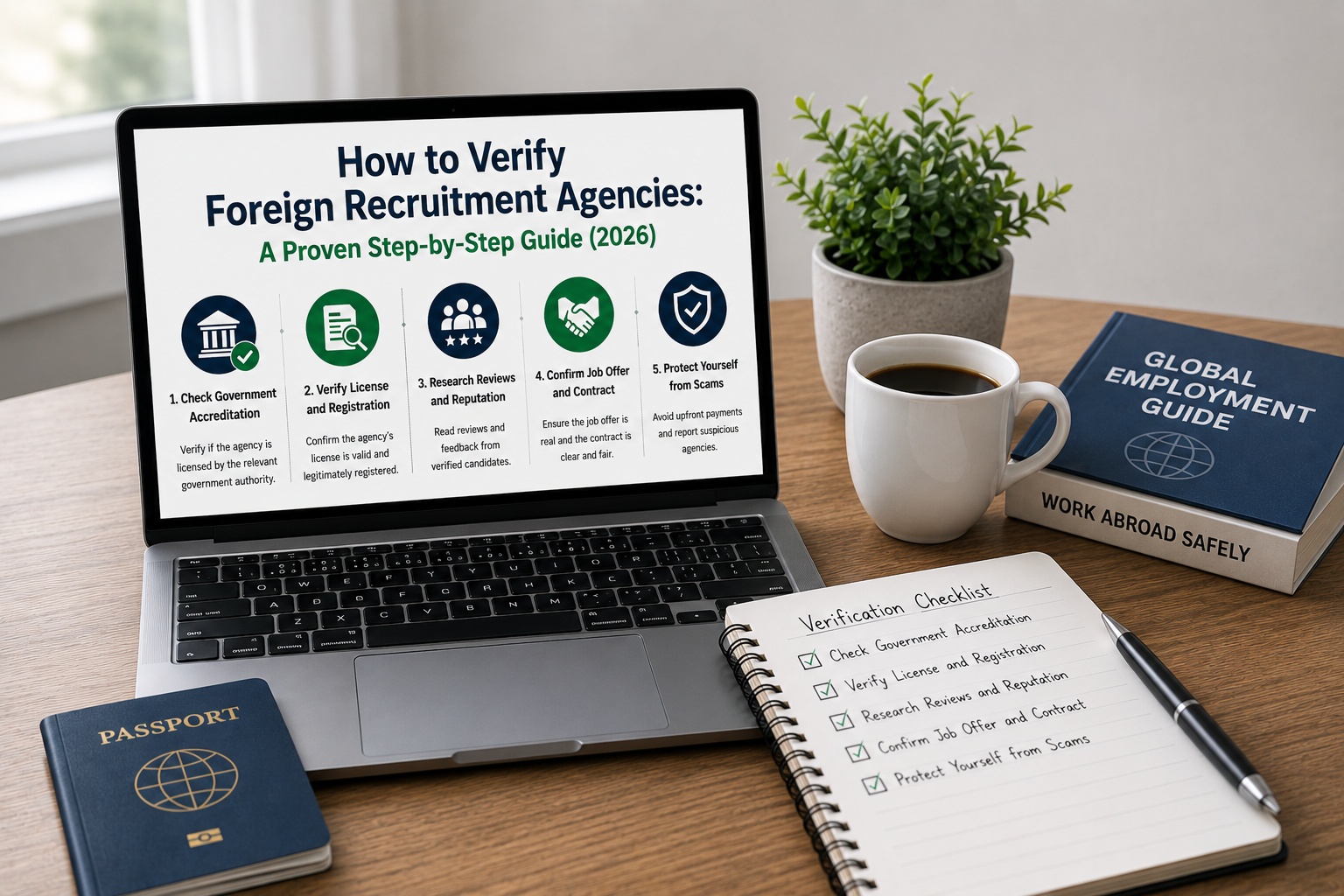
How to Verify Foreign Recruitment Agencies Before They Cost You Everything
Somewhere right now, a father is selling a small plot of land to pay an agency fee for a job in Dubai that does not exist. A young graduate is wiring her last savings to a recruiter she found on Facebook, promising a nursing job in Germany, Canada that never gets processed. This is not a rare tragedy, it is a daily happening. The International Labour Organization has flagged deceptive recruitment as a problem that touches millions of migrant workers every single year, and the pattern repeats itself with painful predictability: a worker pays, waits, and eventually realizes the agency was never real.
If you are reading this, you are probably staring at a job offer abroad and wondering whether the agency behind it is legitimate. Good instinct. Because the single most effective way to protect yourself, your money, and your future is not luck, it is knowing exactly how to verify foreign recruitment agencies before you hand over a passport copy, a fee, or your trust.
In this guide I will walks you through the entire process, step by step, the way an experienced migration counselor would explain it over coffee, no jargon, no fluff, just what actually works.
Why It is So Hard to Verify Foreign Recruitment Agencies Today
Scammers have gotten good. Really good. Gone are the days of obviously fake emails with typos in every sentence. Today’s fraudulent recruiters run polished Facebook ad campaigns, complete with stock photos of gleaming offices and screenshots of successful placements. These ads funnel job seekers straight into WhatsApp groups with tempting names like Canada Jobs 2026 or Dubai Hiring Now, where the real manipulation begins.
What makes this worse is that legitimate agencies and fake ones often look almost identical on the surface same kind of website, same promises of life changing opportunities abroad, same friendly tone. The difference only shows up when you know where to dig. That is exactly why learning to verify foreign recruitment agencies has become an essential life skill for anyone considering work overseas, not an optional precaution.
Step 1: Check the Agency Against an Official Government Registry
This is the single most important step, and it’s also the one people skip most often because it feels like extra work. Don’t skip it.
Every country that regulates labor migration keeps some form of official database or registry of licensed recruiters. If an agency isn’t on that list, it has no legal right to place workers abroad full stop.
Here is where to look depending on where you are:
- United States : The Department of Labor maintains a public Foreign Labor Recruiter List that lets you check recruiters tied to employer job orders under federal disclosure rules.
- Philippines : Agencies must be registered with the Department of Migrant Workers (DMW), formerly POEA, which regularly blacklists agencies found violating recruitment laws.
- Nepal : Licensing runs through the Department of Foreign Employment, and job seekers are encouraged to request and cross-check the agency’s license number directly with that department.
- Pakistan : Verification happens through the Bureau of Emigration and Overseas Employment, and according to one detailed breakdown of how to spot a genuine recruitment agency, agencies that hesitate to share their license number independently are showing a major warning sign.
- Poland : Agencies need both a KRS number (National Court Register) and a KRAZ certificate (Agency Employment Register), both searchable on official Polish government portals.
- Nigeria : Registration falls under the Federal Ministry of Labour and Employment.
- United Kingdom : For employer-side verification, the UK Home Office publishes a Register of Licensed Sponsors, and if the sponsoring company isn’t listed, they legally cannot issue you a visa.
The rule is simple: no registry listing, no deal. It genuinely is that black and white.
Step 2: Request the License Number and Verify It Independently
A legitimate agency will hand over its license number without hesitation, usually before you even ask twice. Fraudulent operators, on the other hand, tend to get vague, change the subject, or suddenly go quiet when pressed for specifics.
Here is how to do this properly:
- Ask for the exact license or registration number, not just we are licensed.
- Don’t just take their word for it, go to the official government portal yourself and search the number.
- Cross-check the agency’s registered name, address, and license status all match what they told you.
- If the license appears expired, suspended, or simply does not exist in the database, walk away.
- This single habit, verifying independently rather than trusting what’s printed on a business card, is what separates people who get scammed from people who do not.
Step 3: Investigate Their Physical and Digital Footprint
Fake agencies love to operate entirely online, with no fixed address and no way to trace them once your money is gone. Genuine agencies, by contrast, tend to have a real, visitable office with actual staff, organized paperwork, and visible registration certificates on the wall.
While you are trying to verify foreign recruitment agencies, look for these footprint signals:
- Physical office : Can you visit it, or does everything happen over WhatsApp?
- Professional email domain : Legitimate firms use their own domain (info@agencyname.com), not Gmail or Yahoo addresses.
- Consistent social media history : A page created three weeks ago with 200 followers is a red flag; a page active for years with genuine engagement is reassuring.
- Independent reviews : Search the agency name plus reviews or scam and check Google Reviews, Trustpilot, or Reddit threads, as recommended in this breakdown of verifying legitimate job offers abroad.
- A real “About Us” page : With named staff and actual photos, not stock imagery recycled across a dozen other sites.
Step 4: Pay Close Attention to How They Handle Fees
This might be the fastest way to unmask a scam. In most countries, including the Philippines, where charging job seekers recruitment fees is outright illegal, the employer, not the worker, is supposed to cover recruitment costs.
Watch out for these fee-related red flags:
- Demands for large upfront payments before any contract is signed
- Requests for payment through informal channels (personal bank transfers, cryptocurrency, cash only)
- Pressure to pay immediately, before the slot is gone.
- Vague explanations of what the fee actually covers.
- Guarantees of a job offer or visa approval in exchange for payment
As one guide focused on Gulf region recruitment put it plainly: under the ILO’s Fair Recruitment Initiative and most destination-country laws, recruitment costs are meant to be borne by the employer, not the job seeker. If an agency wants your money before your job even exists, that is your answer.
Step 5: Verify the Employer, Not Just the Agency
Here is something people often forget, a recruitment agency can be technically real while the job they are recruiting for is completely fabricated. So the verification does not stop at the agency, it extends to the employer on the other end.
- Ask for the employer’s full company name and confirm it exists in the destination country.
- Request a copy of the government-attested employment contract in the UAE, for example, contracts must be registered with MOHRE, and in Saudi Arabia, through the Musaned platform.
- Look the employer up on LinkedIn and see if current employees actually list the company.
- Ask to speak with someone who currently works there, or a past hire who successfully relocated through the same agency.
Table: How to Tell a Legitimate Agency From a Fake One
Sometimes it helps to see everything side by side. Here is a quick comparison you can screenshot and keep handy the next time you are evaluating an offer.
| Signal | Legitimate Agency | Fraudulent Agency |
|---|---|---|
| Government License | Registered and verifiable through an official government licensing portal. | No valid license, or the license number does not match official records. |
| Fees | Fees are charged legally, clearly itemized, or paid by the employer where applicable. | Demands upfront, informal, or “urgent” payments before any verified job offer. |
| Office | Has a genuine, visitable physical office with verifiable contact details. | Operates only online or provides untraceable addresses and contact information. |
| Contract | Provides a detailed, government-attested employment contract before requesting payment. | Offers vague verbal promises or says the contract will be provided “later.” |
| Communication | Uses official company email addresses and scheduled phone or video interviews. | Communicates only through WhatsApp, Telegram, or other messaging apps with no verifiable business contact. |
| Timeline | Hiring process takes several weeks or months and includes proper screening and interviews. | Promises approval within days with little or no screening process. |
| Online Presence | Maintains a long-established website and active, authentic social media profiles. | Uses newly created websites, stock photos, or copied content from other sources. |
| Reviews | Has genuine, traceable reviews with a mix of positive and constructive feedback. | Has no reviews or only suspiciously perfect five-star ratings with little detail. |
Red Flags That Should Make You Walk Away Immediately
If you are still unsure after doing the steps above, trust these instinct level warning signs:
- The salary or benefits sound too good to be true for the role and destination
- You are asked to travel on a tourist visa with a promise to convert it later
- No interview took place with the actual employer only with the agency
- The agency can’t or won’t produce a licensing document on request
- Communication happens exclusively through personal messaging apps
- The agency’s name is a slight variation of a well known, legitimate company
What to Do If You Can’t Verify a Foreign Recruitment Agency
If an agency fails even one of the checks above, don not try to give them the benefit of the doubt. Instead:
- Stop all payments immediately.
- Report the agency to your country’s labor ministry or migrant workers’ department.
- If contacted through a job board or social platform, report the account directly to that platform.
- Warn others by sharing your experience on scam-reporting forums or community groups.
- Keep records of every message, receipt, and document as evidence.
- Reporting is not just about protecting yourself, every report makes it a little harder for that agency to find its next victim.
Jobsroutedaily Final Word Before You Sign Anything
Verifying a foreign recruitment agency isn’t about being paranoid, it is about being informed. The workers who avoid scams aren’t the lucky ones; they are the ones who took an extra hour to check a license number, call an office, or search a registry before wiring money they couldn’t afford to lose.
Take your time. Ask uncomfortable questions. A legitimate agency will never be offended by due diligence only a fraudulent one will.
Also Read 👉How to Write a CV for Canada: The Essential Guide Employers Actually Read
FAQ: How to Verify Foreign Recruitment Agencies
Do legitimate recruitment agencies charge job seekers fees?
In many countries, no. In the Philippines, for instance, it’s illegal for agencies to charge workers recruitment fees, the employer is legally required to cover them. Rules vary by country, so always check local regulations before paying anything.
How do I check if an agency’s license number is real?
Search the official government portal for your country’s labor or overseas employment authority and enter the license number directly. Never rely on a number printed on a flyer or business card alone.
What if the agency has a professional-looking website?
A polished website means nothing on its own. Fraudulent operators often build convincing sites using stock photography and copied content. Always cross-check licensing independently, regardless of how professional the site looks.
Can an agency guarantee me a visa or job approval?
No. No agency can guarantee a government’s decision on a visa or work permit. Any agency claiming otherwise is either misinformed or lying.
What should I do if I’ve already paid a suspicious agency?
Stop further payments immediately, gather all documentation, and report the agency to your local labor authority or consumer protection agency as soon as possible.
How long does legitimate overseas recruitment usually take?
Typically two to six months, including interviews, document verification, medical exams, and government processing. Anything promising approval within days should raise immediate suspicion.
About the Author:
Henry Mbah, is a career and education writer Jobsroutedaily specializing in international jobs, scholarships, visa sponsorship opportunities, and career guidance. Passionate about helping readers access reliable information to achieve their education and employment goals.