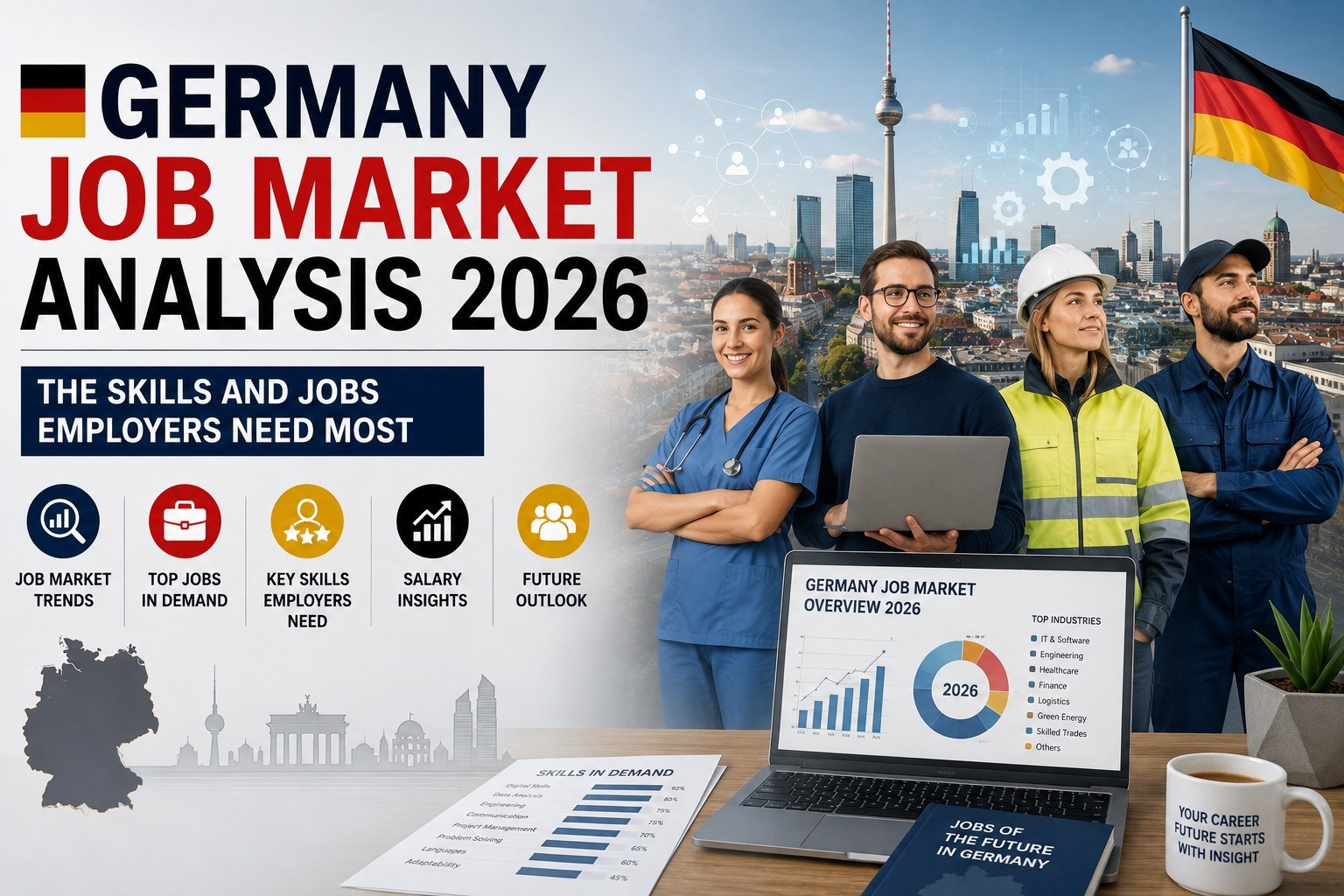
Germany Job Market Analysis 2026: The Skills and Jobs Employers Need Most
Germany’s labour market is undergoing a significant structural change over time.
An ageing population, declining numbers of younger workers and continued demand for qualified employees are increasing the importance of international recruitment. The Federal Employment Agency (Bundesagentur für Arbeit, BA) reported in July 2026 that employment growth since 2024 has been driven exclusively by foreign workers, while employment among German nationals has increasingly slowed as a result of demographic ageing.
But there is an important distinction that international job seekers need to understand:
Germany does not have a shortage of workers in every occupation.
The BA’s 2025 shortage occupation analysis identified 157 occupations experiencing skilled worker shortages, down from 163 in 2024. Shortages were particularly concentrated in nursing and other healthcare professions, construction and skilled trades. The analysis also identified strong demand for cooks, professional drivers, educators and other occupations.
For an international applicant, therefore, the better question is not simply:
Does Germany need foreign workers?
It is:
Does Germany need my particular skills, qualifications and experience?
This JobsRouteDaily analysis examines that question.
Quick Summary
Our analysis of current German labour market evidence finds several important trends:
- Healthcare and nursing remain among the clearest areas of shortage.
- Construction and skilled trades continue to experience recruitment pressure.
- Professional drivers and cooks are also identified among occupations with strong demand.
- Germany is increasingly relying on international workers to offset demographic pressure.
- German language ability can significantly improve employment prospects.
- Recognition of foreign qualifications is particularly important for regulated professions.
- Employers are increasingly encouraged to make vacancies more accessible to international applicants.
- Having a qualification alone does not guarantee employment; applicants must match the requirements of the specific occupation and employer.
Why Germany Is Recruiting More International Workers
Germany’s demographic situation is one of the biggest forces shaping its labour market.
According to the Federal Employment Agency, the number of working age people with German nationality fell by around 3.9 million between 2014 and 2024, while the working age foreign population increased by around 3.4 million during the same period.
This does not mean that every German company is actively searching overseas for employees.
Instead, it means immigration has become an increasingly important component of maintaining the country’s workforce.
The BA reported that foreign workers accounted for a growing share of employment in shortage occupations, with their share approximately doubling since 2014 to around 14%.
This creates opportunities for qualified international candidates—but those opportunities are concentrated in particular sectors.
Which Occupations Are in Demand?
Germany’s official 2025 shortage analysis provides one of the clearest pictures of where recruitment pressure remains strongest.
1. Nursing and Healthcare
Healthcare is one of the most significant areas of labour shortage.
Nursing professionals, medical occupations and related healthcare roles continue to experience recruitment pressure.
This is particularly important for international applicants because healthcare professions are often regulated.
Foreign nurses, for example, generally need recognition of their professional qualification and the relevant professional licence before they can work fully in the regulated profession in Germany.
What this means for applicants
A nursing qualification from another country can be valuable, but simply holding the qualification is not enough.
Applicants should investigate:
- German qualification recognition
- Professional licensing
- German-language requirements
- Employer requirements
- Relevant clinical experience
- Immigration requirements
For healthcare professionals, preparation should begin before applying for jobs.
2. Construction and Skilled Trades
Construction and skilled trades remain another important area of demand.
Germany’s shortage analysis identifies several construction and craft occupations among the country’s shortage areas.
This creates potential opportunities for qualified workers such as tradespeople and technicians whose experience matches German occupational requirements.
However, applicants should not assume that every construction vacancy is open to international candidates.
Employers may require:
- Recognised vocational qualifications
- Relevant work experience
- Technical skills
- German-language ability
- Safety knowledge
- Specific licences or certifications
For skilled trades, demonstrating practical competence can be just as important as presenting a formal qualification.
3. Professional Drivers
Professional drivers are another occupation specifically highlighted by Germany’s Federal Employment Agency as experiencing strong demand.
This includes roles associated with commercial transport and logistics.
International applicants should pay particular attention to the exact driving licence and professional qualifications required for the position.
A foreign driving licence does not automatically mean that an applicant can immediately perform every professional driving role in Germany.
Before accepting an offer, candidates should verify:
- Required licence category
- Recognition or exchange requirements
- Professional driver qualifications
- German-language expectations
- Employer-specific requirements
4. Cooks and Hospitality Related Roles
Cooks are also identified among occupations with strong recruitment demand in Germany.
This is particularly relevant for experienced chefs and cooks with formal culinary training or substantial professional experience.
For international applicants, useful evidence can include:
- Culinary qualifications
- Restaurant experience
- Specialised cuisine experience
- Food-safety training
- References
- German or English communication ability
However, applicants should distinguish between high demand and easy immigration.
An occupation appearing on a shortage list does not automatically guarantee a visa or employment.
5. Education and Social Professions
Germany’s shortage analysis also identifies educators among occupations experiencing strong demand.
International candidates considering education or social care professions should pay particular attention to recognition requirements because many roles in these areas can involve regulated or state-specific professional requirements.
This means an applicant should determine:
- Whether the profession is regulated.
- Which authority handles recognition.
- Whether additional training is required.
- What German-language level is expected.
- Whether the employer accepts international applicants.
The Skills German Employers Are Looking For
A major lesson from Germany’s international recruitment strategy is that employers are not simply looking for people with certificates.
They need workers whose qualifications, practical skills and experience correspond to an actual vacancy.
Germany’s Federal Employment Agency advises employers recruiting internationally to describe required qualifications clearly, explain German language expectations, provide concrete salary information where possible and explain what support international workers can receive before and after arrival.
From an applicant’s perspective, this suggests several important priorities.
Technical Competence
Your CV should clearly show what you can actually do.
Instead of listing:
Experienced electrician👇
explain the relevant technical experience, systems worked with, responsibilities and certifications.
Relevant Professional Experience
Experience can strengthen an application considerably, particularly when it directly corresponds with the vacancy.
Use specific examples rather than generic statements.
Language Skills
German language ability can be a major advantage.
The Federal Employment Agency explicitly advises international applicants that good German skills improve their chances of finding work and notes that many companies expect at least basic German, for some professions, specific German language skills are mandatory.
For international applicants, learning German should therefore not be treated as an optional extra.
It can be part of your employment strategy.
The Qualification Recognition Problem
One of the biggest mistakes international applicants make is assuming that an overseas qualification automatically has the same professional status in Germany.
It does not always.
Germany distinguishes between regulated and non regulated professions.
For regulated professions, recognition and/or professional licensing can be necessary. Examples include many healthcare professions, certain teaching roles and some other regulated occupations.
For non regulated occupations, formal professional recognition is generally not required simply to practise the occupation, although recognition may still matter for particular immigration routes and can help employers understand the applicant’s qualifications.
The recognition process normally involves the relevant German authority comparing an international qualification with the appropriate German reference qualification.
The official Make it in Germany guidance says the assessment generally takes around three to four months once the required documents have been submitted, although actual processing times can vary.
Germany Qualification Recognition: 9-Step Checklist
For international job seekers, having the right qualification is only the beginning.
A diploma, vocational certificate, nursing qualification or professional licence earned outside Germany may need to be assessed before an employer or German authority can determine how it compares with the corresponding German qualification.
This is particularly important for people targeting the occupations highlighted earlier in this report, including nursing, healthcare, education and certain skilled trades.
But there is an important misconception to clear up:
Not every foreign qualification needs formal recognition before you can work in Germany.
Whether recognition is required depends primarily on the occupation, the type of qualification and, in some cases, the immigration route you intend to use. Germany’s official Make it in Germany guidance distinguishes between regulated and non regulated professions.
Understanding this distinction can save applicants considerable time and prevent them from paying for the wrong type of assessment.
What Does RECOGNITION Actually Mean?
Foreign qualification recognition is essentially an official comparison between a qualification obtained abroad and a corresponding German reference qualification.
The competent German authority examines the applicant’s education, training and other relevant evidence and determines whether it is equivalent to the German reference occupation.
The outcome can include:
- Full recognition
- Partial recognition
- No recognition
The exact process and responsible authority depend on the occupation.
For international applicants, the recognition decision can therefore be an important document when applying for employment, professional licensing or certain immigration routes.
Step 1: Find Your German Reference Occupation
Before submitting anything, determine what German occupation corresponds most closely to your qualification.
This is one of the most important steps because the recognition authority does not simply assess a certificate in isolation.
It compares your qualification with a specific German reference occupation.
Germany’s official Recognition Finder helps applicants identify the relevant profession, determine whether it is regulated and find information about the responsible recognition authority.
For example, an overseas nurse should not simply search for degree recognition Germany.
The applicant should identify the appropriate German nursing profession and then determine the authority responsible for professional recognition.
Similarly, someone with a technical or vocational qualification should identify the closest German reference occupation before beginning the process.
JobsRouteDaily Tip:
Do not start by paying for an assessment. Start by identifying the occupation.
The reference occupation determines what recognition procedure you need, which authority handles it and what documentation you may have to provide.
Step 2: Determine Whether Your Profession Is Regulated
This is the next major decision.
Regulated Professions
A regulated profession is one where German law establishes specific requirements for practising the profession.
Examples include many professions in:
- Healthcare
- Medicine
- Teaching
- Law
For regulated professions, foreign-qualified applicants generally need recognition of their qualification and, where applicable, a professional licence before practising the profession in Germany.
This is especially important for international nurses.
Having a nursing degree from another country does not by itself mean that you can immediately work in Germany as a fully licensed nurse.
You need to follow the professional recognition and licensing requirements applicable to the occupation.
Non-Regulated Professions
Many occupations in Germany are non regulated.
For these professions, formal professional recognition is generally not compulsory simply to practise the occupation. However, recognition or an assessment of the qualification can still be useful because it helps employers understand the level and content of an overseas qualification.
This distinction is crucial.
An international applicant may see a statement saying:
Recognition is not required.
That does not necessarily mean recognition is irrelevant.
Recognition may still be useful for demonstrating the comparability of your qualification, and particular immigration routes can have their own evidence requirements.
Step 3: Check the Immigration Route You Intend to Use
Employment recognition and immigration requirements are related, but they are not exactly the same thing.
A person may not need formal professional recognition to practise a particular non regulated occupation, yet the immigration route they are using may require evidence concerning their foreign qualification.
The official Make it in Germany guidance specifically warns that recognition can be relevant to visa applications and that requirements depend on the intended residence title and profession.
This is why applicants should avoid relying on statements such as:
My profession is not regulated, so I don’t need any qualification assessment.
The correct question is:
What does my profession require, and what does my intended immigration route require?
Those can be different questions.
Step 4: Gather Your Documents
Once you know the correct recognition procedure, begin preparing your documents.
The exact list varies according to the profession and authority, but applicants may be asked for documents relating to:
- Identity
- Professional qualification
- Education and training
- Work experience
- Professional history
- Existing licences or registrations
- Other evidence relevant to equivalence
The official Recognition in Germany portal explains that applicants may need German translations of documents, depending on the responsible authority and the specific application.
Do not automatically translate every document before checking the requirements.
The responsible authority determines whether a translation is necessary and what type of translation is accepted.
Important
Some authorities may have specific rules concerning certified copies or translations.
Therefore, check the requirements before paying a translator or certification service.
Step 5: Submit Your Application to the Correct Authority
Recognition is not handled by one single national office for every occupation.
The competent authority depends on the profession and, in some cases yes the federal state.
The official Recognition Finder is designed to help applicants identify the relevant authority and obtain profession specific information.
Depending on the profession, the responsible organisation could be a government authority, professional body, chamber or another competent institution.
This is another reason why applicants should avoid sending documents randomly to agencies advertising Germany qualification recognition.
The application should go through the officially responsible authority.
Step 6: The Authority Compares Your Qualification
Once the required documentation has been submitted, the authority assesses the foreign qualification against the relevant German reference occupation.
The purpose is to determine whether the education and training are equivalent or whether substantial differences exist.
According to official German guidance, the assessment generally around three to four months once the required documentation is complete, although specific procedures and circumstances can affect the timeline.
This is why applicants should not leave recognition until the last minute.
If your intended career depends on professional recognition, beginning the process early can make the wider job and immigration process much easier to manage.
Step 7: Understand the Possible Results
The outcome is not necessarily simply recognised or rejected.
There can be different outcomes.
Full Recognition
Your qualification is considered equivalent to the relevant German qualification.
For regulated professions, other requirements such as professional licensing may still apply.
Partial Recognition
The authority determines that your qualification corresponds to the German reference qualification in some respects but that significant differences remain.
The recognition notice explains the relevant differences.
This can provide a roadmap for further training or adaptation.
Partial recognition is therefore not necessarily the end of the process.
It can tell you exactly what additional steps may be required.
No Recognition
The authority may determine that the qualification does not meet the required equivalence criteria.
The implications depend on the occupation and the reason for the decision.
Applicants should carefully read the official decision rather than assuming that they can never work in Germany.
In some circumstances, additional qualification measures may provide another route forward.
Step 8: Complete Additional Training if Required
A partial recognition decision can identify gaps between an applicant’s training and the German reference qualification.
Depending on the occupation, these gaps may potentially be addressed through further training, adaptation measures or other qualification activities.
For regulated professions, the competent authority determines the appropriate compensatory measures.
This is particularly relevant to internationally trained healthcare professionals.
Instead of viewing a partial recognition decision as a failure, applicants should treat it as a roadmap showing what remains to be completed.
What If Some Documents Are Missing?
Not every international applicant has a perfect archive of educational documents.
Documents can sometimes be unavailable because of institutional closures, administrative problems or other circumstances.
Germany’s recognition system provides for a qualification or skills analysis in certain situations where the necessary documents are missing or incomplete. The competent authority determines whether such an assessment is appropriate.
Applicants should not simply abandon the process because one document is difficult to obtain.
Instead, explain the situation to the competent recognition authority or an official counselling service and ask what alternatives are available.
How Much Does Recognition Cost?
There is no single nationwide price that applies to every recognition application.
Fees depend on the competent authority and procedure.
The official Recognition in Germany information shows that recognition procedures can involve fees, with additional expenses potentially arising from translations, certifications or compensatory measures.
This means applicants should budget for more than the basic application fee.
Potential expenses can include:
- Recognition fees
- Document translation
- Certification
- Language training
- Additional qualification measures
- Professional examinations
JobsRouteDaily Tip
Before spending money, create a simple recognition budget.
Write down:
Application fee + translation + certification + language training + possible additional qualification costs.
This gives you a more realistic estimate of the total process.
What About Foreign University Degrees?
Academic qualifications are handled somewhat differently from vocational professional qualifications.
For some non regulated academic professions, formal professional recognition is not required simply to work in the profession.
However, applicants from outside the EU may need evidence that their foreign academic degree is comparable to a German degree for particular immigration routes. The official Make it in Germany guidance points applicants toward the anabin database and, where necessary, a Statement of Comparability from Germany’s Central Office for Foreign Education (ZAB).
Anabin
Anabin is a database used to assess information about foreign higher education institutions and qualifications.
If the relevant institution and qualification information is available and meets the applicable criteria, the database may provide useful evidence of comparability.
Statement of Comparability
If the necessary information is not adequately covered in anabin, applicants may need an individual Statement of Comparability from ZAB.
The official German guidance states that this is an official document describing a foreign university qualification and indicating the German qualification to which it is comparable.
This is different from professional recognition for a regulated occupation.
That distinction is important when planning an application.
A Special Option: Recognition Partnership
Germany also provides a recognition partnership route in certain circumstances.
Under this arrangement, eligible skilled workers from third countries can enter Germany and continue the recognition process while taking up qualified employment, subject to the applicable residence requirements and conditions. The relevant residence title is issued initially for one year and can be extended under the rules, up to a maximum of three years.
For a recognition partnership, the official guidance states that the foreign qualification must be formally recognised by the country where it was obtained, and German language skills of at least A2 are required for the residence arrangement.
This is a potentially important option for some international professionals, but it should not be treated as a universal shortcut.
Eligibility depends on the individual’s occupation, qualification, employer and immigration circumstances.
What If My Qualification Is Only Partially Recognised?
Do not immediately give up.
A partial recognition decision tells you that the German authority identified substantial differences between your qualification and the German reference qualification.
Read the recognition notice carefully.
It should help you understand:
- What the authority considered equivalent
- What differences were identified
- What additional training may be required
- What examination or adaptation measures may apply
For regulated professions, the competent authority determines the compensatory measures required. For non regulated occupations, additional qualification can sometimes be used to address identified differences before seeking full recognition.
A Practical Recognition Checklist for International Job Seekers
Before starting your application, work through this checklist:
Qualification
- Identify the exact qualification you hold.
Occupation
- Identify the German reference occupation.
Regulation
- Determine whether the occupation is regulated.
Authority
- Find the competent recognition authority.
Documents
- Collect certificates, transcripts and relevant professional evidence.
Translation
- Check whether German translations are required.
Immigration
- Determine whether your intended visa or residence route has additional qualification requirements.
Language
- Check the language requirements for both the occupation and your immigration route.
Application
- Submit your documentation through the appropriate authority.
Outcome
- Read the recognition notice carefully.
Next Steps
- If differences are identified, determine whether further training or adaptation is required.
JobsRouteDaily Analysis: Recognition Can Be a Career Strategy
Qualification recognition should not be treated merely as immigration paperwork.
It can be part of your job-search strategy.
Suppose two international candidates apply for a German vacancy.
Candidate A writes:
“I have a nursing degree from another country.”
Candidate B writes:
“I hold a nursing qualification from Nigeria, have completed the German recognition process, and have received confirmation of equivalence.”
The second candidate has removed an important source of uncertainty for the employer.
That does not guarantee employment, but it can make the candidate’s professional status much easier for an employer to understand.
For this reason, international applicants should consider starting recognition before they begin applying aggressively for jobs when their profession requires or strongly benefits from it.
The Bigger Picture for Germany’s 2026 Labour Market
This recognition process connects directly to the central finding of our Germany Job Market Analysis.
Germany may need more international workers, but employers need qualified people whose skills can be matched to actual occupations.
The pathway therefore looks something like:
Identify the occupation → check shortage demand → determine recognition requirements → prepare documents → obtain recognition where required → improve German → target suitable employers → pursue the appropriate immigration route.
That is a much stronger strategy than simply searching for Germany visa sponsorship jobs.
What International Applicants Should Put on Their CV
A Germany-focused CV should make it easy for an employer to understand your professional background.
Include:
Professional title
Clearly state the occupation you are applying for.
Qualification
Name the qualification, institution and year obtained.
Experience
Give dates, employers, responsibilities and relevant achievements.
Technical skills
List skills that directly correspond to the vacancy.
Language skills
State your actual German and English proficiency honestly.
Certifications
Include relevant licences, professional certificates and training.
Recognition status
If applicable, explain whether your qualification has already been recognised in Germany or whether recognition is in progress.
This transparency can reduce uncertainty for employers.
What Employers Need From International Candidates
Germany’s Federal Employment Agency has increasingly developed support systems for companies recruiting workers from abroad.
The agency and its international recruitment network help employers find candidates, navigate employment requirements and recruit from EU and non EU countries.
The official Make it in Germany platform also serves as a government resource for international skilled workers.
This matters because international recruitment is not simply about finding a vacancy online.
There is a wider process involving:
Job → Qualification → Recognition → Language → Immigration → Employment
Understanding that sequence can prevent unrealistic expectations.
JobsRouteDaily Analysis: The Biggest Opportunity
Our analysis suggests that the strongest opportunities for international applicants are concentrated where three factors overlap:
1. Germany has a genuine labour shortage.
2. Your occupation matches that shortage.
3. Your qualification and experience can be recognised or accepted.
If one of those elements is missing, the opportunity becomes considerably weaker.
For example, being an experienced professional in an occupation with little current shortage may produce fewer opportunities than being a moderately experienced candidate in a high-demand occupation.
This is why international applicants should research the occupation before spending significant time and money on relocation plans.
What This Means for Job Seekers in 2026
If you are considering Germany, don’t start by asking:
Which agency can get me a German job?
Start with:
Which German occupations match my qualifications and experience?
Then work backwards.
Step 1
Identify your occupation.
Step 2
Check whether it is regulated.
Step 3
Check Germany’s current shortage information.
Step 4
Determine whether recognition is required.
Step 5
Improve your German language ability.
Step 6
Build a Germany focused CV.
Step 7
Target employers with genuine vacancies.
Step 8
Investigate the appropriate immigration route.
This approach is more sustainable than applying randomly to hundreds of vacancies.
Common Mistakes International Applicants Should Avoid
Applying for Everything
A large number of applications does not compensate for poor job matching.
Ignoring German
English-only opportunities exist, but the Federal Employment Agency specifically notes that German skills improve job prospects and that many employers expect at least basic German.
Assuming Every Qualification Is Automatically Recognised
Recognition requirements depend on the occupation and immigration route.
Paying for Unverified Job Offers
International applicants should independently verify employers, contracts and recruitment arrangements before making financial commitments.
Confusing a Shortage Occupation With a Guaranteed Job
A shortage designation indicates labour-market pressure. It does not guarantee employment, sponsorship or immigration approval.
Frequently Asked Questions
Is Germany currently hiring foreign workers?
Yes. Foreign workers are playing an increasingly important role in Germany’s employment growth, and official data shows their contribution has become particularly important as demographic pressures increase.
Which jobs are most in demand in Germany?
Current official shortage analysis identifies strong demand in areas including nursing and healthcare, construction and skilled trades, professional driving, cooking and education.
Do I need to speak German to work in Germany?
Not every job has the same language requirement, but German can significantly improve your employment prospects. Some professions have specific language requirements.
Do foreign qualifications need to be recognised?
It depends on the occupation and immigration route. Regulated professions generally require recognition and/or professional licensing, while many non-regulated professions do not require formal professional recognition to practise.
How long does qualification recognition take?
Official guidance indicates that the assessment generally takes around three to four months once complete documentation has been submitted, although processing times can vary.
Does a shortage occupation guarantee a visa?
No. Shortage status is only one part of the overall process. Applicants must still satisfy the requirements of the relevant employment and immigration route.
Final Verdict
Germany remains an important destination for international workers, but the opportunity is becoming more skills-specific, not simply broader.
The country’s demographic situation is increasing reliance on international workers, while official labour market analysis continues to identify shortages in healthcare, construction, skilled trades, transport, hospitality and education.
For international applicants, the winning strategy is therefore not to chase every advertisement that promises a German job.
It is to build a profile that matches a genuine labour-market need.
A strong candidate combines:
Relevant qualification + practical experience + language ability + recognised credentials + targeted applications.
That is the central finding of this JobsRouteDaily analysis.
Germany needs international workers, but the biggest opportunities will continue to go to candidates whose skills solve a real employer problem.
Official Resources
For readers researching employment in Germany, the following official resources should be used to verify current requirements:
- Federal Employment Agency, labour market and shortage occupation information
- Make it in Germany, official information for international skilled workers
- Recognition in Germany qualification recognition information
- German immigration authorities current residence and visa requirements
Immigration and employment rules can change, so readers should verify requirements using current official information before making decisions.
Related JobsRouteDaily Resources
Germany Visa Sponsorship Jobs: How International Applicants Can Find Legitimate Opportunities
JobsRouteDaily Editorial Note
This article is part of the JobsRouteDaily International Labour Market Analysis Series. It combines current official labour market information with JobsRouteDaily editorial analysis. It does not represent a guarantee of employment, visa sponsorship or immigration approval.
Because labour market conditions, shortage classifications, vacancies and immigration rules can change, readers should verify occupation specific requirements and immigration conditions through the relevant German authorities before applying.
Research sources reviewed: Federal Employment Agency (Bundesagentur für Arbeit), Make it in Germany and Germany’s official labour market/ statistical resources.