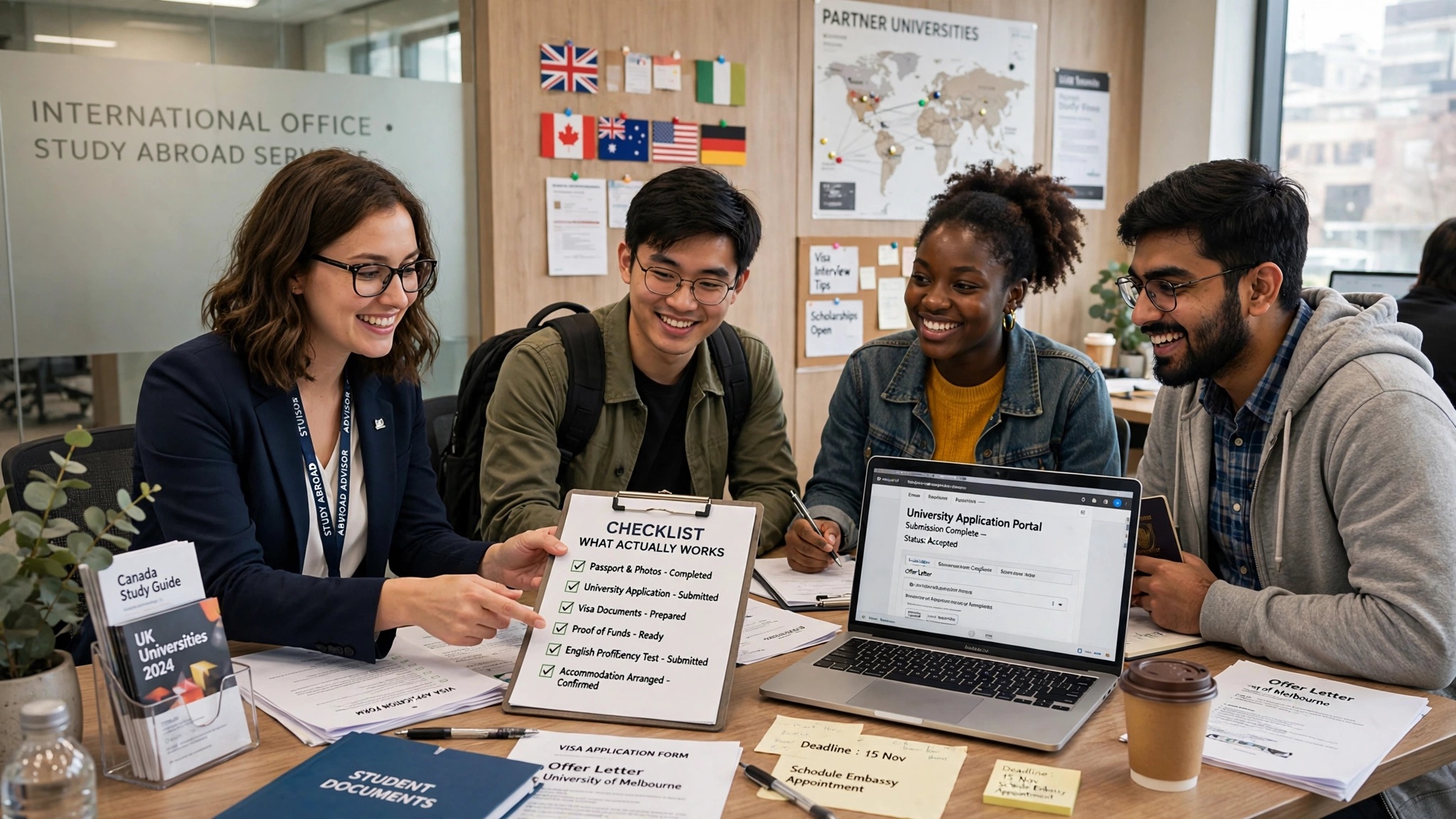
Study Abroad Assistance for International Students: What Actually Works
Chidinma had eleven browser tabs open. One was a study abroad consultancy in Lagos asking for ₦450,000 upfront processing fee. Another was a Facebook group where someone swore they got a full scholarship to Germany, just by emailing professors directly. A third was the actual university website, which she had not touched in three days because it felt less exciting than the promises everywhere else.
If this sounds like your evening right now, you are not alone. Every year, thousands of ambitious students across Nigeria, Ghana, Kenya, and Zimbabwe start the study abroad process the same way, overwhelmed, half informed, and one bad decision away from losing money they do not have to spare.
Here is the thing nobody tells you upfront: most of the assistance you actually need is either free or built into the application process itself. The paid stuff that’s worth it is narrow and specific. Let’s sort out which is which.
Why Study Abroad Assistance Gets Confusing Fast
The confusion is not your fault. The study abroad help industry is genuinely messy legitimate university international offices, real scholarship databases, and predatory consultants all show up in the same Google search results and the same WhatsApp groups.
Add to that the fact that requirements change by country, by university, and sometimes by intake year, and you get a situation where even smart, resourceful people end up paying for things they could have gotten for free or worse, missing things that actually mattered because they were focused on the wrong task.
The Three Types of Assistance You will Encounter
- Free institutional support : university international student offices, government education portals, embassy education advisors
- Free to low cost tools : scholarship search engines, SOP feedback communities, alumni mentorship
- Paid services : education agents, visa consultants, application boot camps
The trick is knowing which category actually solves your specific problem, instead of defaulting to whichever one has the loudest marketing.
What Legitimate Study Abroad Assistance Looks Like
1. University International Student Offices
This is the most underused resource by far. Almost every university with international enrollment has a dedicated office sometimes called International Student Services or Global Engagement whose entire job is helping you get admitted, funded, and settled.
They can usually help with:
- Clarifying admission requirements specific to your country
- Confirming which documents need notarization or translation
- Connecting you with current students from your region
- Explaining visa letter and I-20/CAS equivalent processes
- Pointing you to internal scholarship or assistantship opportunities
This is free. You email them directly. No consultant needed for this layer.
2. Government and Embassy Education Advising
Several countries run free education advising services specifically to attract international students, these are government funded, not commission based, which matters because commission based advisors are often pushing you toward whichever school pays them the most.
Look for terms like, education USA, British Council education advising, Campus France, or DAAD information centre depending on your target country. These services exist precisely so you don’t have to pay a private agent for basic guidance.
3. Scholarship Databases (Not Scholarship Guarantees)
Be skeptical of anyone who says they can guarantee you a scholarship. Nobody can. What legitimate scholarship search tools do is aggregate real, verified opportunities so you are not manually searching a hundred university websites.
Use these to build a list, then apply directly through the official scholarship or university portal, never through a third party who asks for payment to submit on your behalf.
4. SOP and Essay Feedback Communities
Your statement of purpose matters more than most people realize, and getting a second pair of eyes on it is genuinely useful. This does not require paying $200 for a template. Alumni networks, university subreddits for your target program, and even professors who have supervised international students before can give feedback that’s far more specific than a generic paid service.
Free vs Paid: A Comparison Table
| Type of Help | Cost | Best For | Red Flag Version |
|---|---|---|---|
| University International Office | Free | Country-specific admission questions, application guidance, and university support services | Not applicable, official university international offices are legitimate sources of information. |
| Government Education Advising Centre | Free | Choosing a study destination, understanding education systems, and general application guidance | Not applicable, official government advising centres are trustworthy. |
| Scholarship Search Platforms | Free | Finding and comparing scholarship opportunities | Platforms that ask for payment to “unlock” scholarship listings or applications. |
| Alumni or Student Mentorship | Free to Low Cost | Receiving practical, first-hand advice from current or former students | “Mentors” who pressure you to use a particular education agent or paid service. |
| Licensed Education Agent | Usually paid by the university (not the student) | Managing complex applications or applying to multiple universities | Agents demanding large upfront fees or making unrealistic admission guarantees. |
| Visa Consultant | Paid | Applicants with complex immigration histories or previous visa refusals | Anyone who guarantees visa approval or claims to have special influence over immigration authorities. |
| SOP / Personal Statement Writing Service | Paid | Editing and improving your own Statement of Purpose or application essays | Services that offer to write the entire essay for you instead of helping you improve your own work. |
Red Flags: How to Spot a Study Abroad Scam
This is the part that actually protects your money, so read it twice.
Checklist, Walk Away If You See:
- Upfront processing fees before any application is even submitted
- Guarantees of admission, scholarship, or visa approval
- Pressure to decide within 24–48 hours
- Payment requested via personal bank transfer, not an institutional account
- No verifiable physical office or professional email domain
- Refusal to let you speak with past clients
- Vague answers when you ask which specific universities they are affiliated with
Legitimate agents are usually paid by the university (through a commission structure), not by you directly. If someone is asking you for thousands upfront before any offer letter exists, that is your signal to leave.
Building Your Own Assistance Plan
You do not need to pick one type of help and stick with it. A realistic plan usually layers three things:
- Foundation: Government/embassy advising to choose your country and understand the system
- Execution: University international offices, direct communication with admissions
- Refinement: Peer/alumni feedback on your SOP, plus a scholarship database for funding
If you are applying to multiple countries at once and genuinely can’t manage the coordination alone, that’s when a licensed, verifiable agent starts to make sense, but only after you have exhausted the free layers first.
A Quick Reality Check
Nobody, no consultant, no platform, no article, including this one can promise you an outcome. What good assistance actually does is reduce wasted time and protect you from unnecessary costs. If a service cannot explain clearly what it is doing differently from something you could do yourself for free, that’s worth questioning before you pay.

FAQ: Study Abroad Assistance for International Students
1. Do I need to pay an agent to study abroad?
No, not always. Many students apply successfully using only free university and government resources. Paid agents are useful mainly when managing multiple complex applications at once.
2. How do I know if a study abroad consultant is legitimate?
Check if they are affiliated with recognized universities, ask for verifiable past client references, and confirm how they’re paid. Legitimate agents are typically compensated by universities, not by charging you large upfront fees.
3. Are scholarship databases actually free?
Most reputable ones are free to search. Be cautious of any platform charging you money to access or unlock scholarships official scholarships never require a payment to apply.
4. What’s the difference between an education agent and a visa consultant?
An education agent helps with university selection and applications. A visa consultant specifically handles visa documentation and interview preparation. Some services offer both, but they are distinct skill sets.
5. Can university international offices really help before I’m even admitted?
Yes. Most will answer prospective student questions about requirements, documents, and general process even before you apply, this is part of their role in recruiting international students.
6. Should I trust study abroad advice from Facebook or WhatsApp groups?
Use it as a starting point, not a final answer. Peer experiences are valuable for realistic expectations, but always verify specific requirements directly with the official university or embassy source.
That is it no upfront fees, no guarantees, just the actual resources that get you from overwhelmed with tabs open to application submitted. Take it one layer at a time.
About the Author:
Henry Mbah, is a career and education writer specializing in international jobs, scholarships, visa sponsorship opportunities, and career guidance. Passionate about helping readers access reliable information to achieve their education and employment goals.