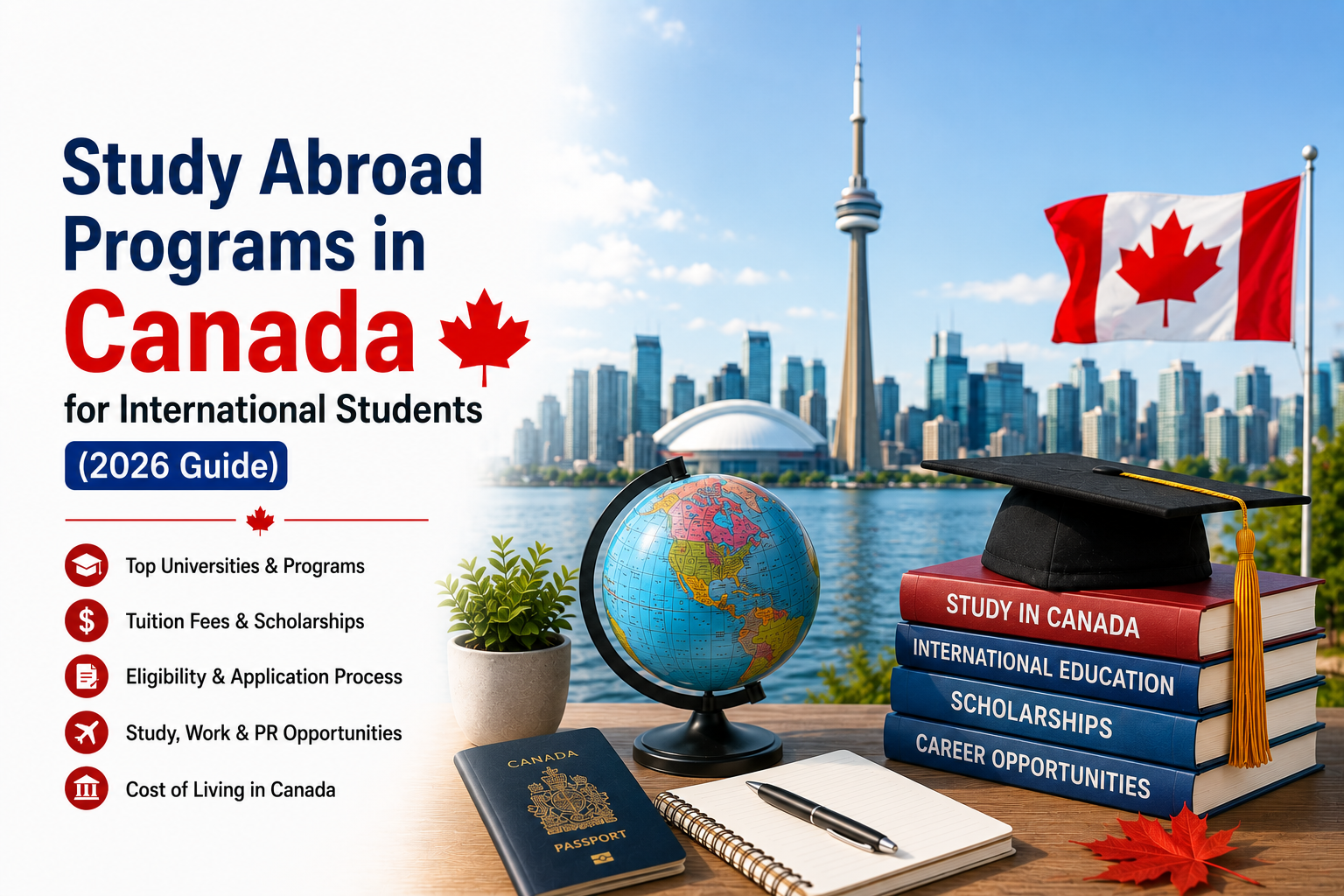
Study Abroad Programs in Canada for International Students
Canada has spent the last two years rewriting its own rulebook, and if the last guide you read about studying there is more than a year old, it’s probably already out of date. Study permit caps, provincial attestation letters, new proof of funds thresholds, the system in 2026 looks meaningfully different from the one that made Canada famous as an easy, welcoming study destination just a few years ago.
None of that means Canada has stopped being a great option. It just means study abroad programs in Canada for international students now require sharper planning than they used to. This guide breaks down exactly what has changed, what hasn’t, and how to build an application that actually gets approved.
Why Study Abroad Programs in Canada Still Attract International Students
Despite the tighter rules, Canada remains one of the more attractive destinations for a genuinely simple reason: quality education at a lower relative cost than the US, UK, or Australia. A few things keep pulling students in:
- Globally ranked universities, the University of Toronto, McGill, and the University of British Columbia routinely appear among the world’s top 50.
- Comparatively lower tuition than similarly ranked US or UK institutions, even after recent fee increases.
- Post-graduation work opportunities through the Post-Graduation Work Permit (PGWP), which lets many graduates stay and work in Canada after finishing their degree.
- A genuine, if narrower, pathway to permanent residency for students who complete their studies and gain Canadian work experience.
The trade off is that getting in has become noticeably more competitive and paperwork heavy which makes understanding the current rules non-negotiable before you apply.
Understanding the Study Permit Process for International Students in Canada
A study permit is the document that authorizes you to study at a Designated Learning Institution (DLI) in Canada it is not the same as your visa or electronic travel authorization, which control entry into the country.
For 2026, the biggest structural change is the international student cap. According to Canada’s official 2026 provincial and territorial allocations notice, IRCC will accept 309,670 study permit applications requiring a Provincial or Territorial Attestation Letter (PAL/TAL) for the year, with each province responsible for distributing its own allocation among its institutions.
Key things every applicant should know:
- Most undergraduate and college applicants need a PAL/TAL submitted alongside their study permit application; applications without one are returned unprocessed.
- Master’s and doctoral students at public institutions are now exempt from the PAL/TAL requirement as of January 1, 2026, a deliberate move to attract more research-focused talent.
- Joint programs across multiple institutions now only require a single PAL/TAL, a change introduced in February 2026 that simplifies what used to be a multi-letter headache.
- Proof of funds thresholds have risen. As of September 2025, applicants studying outside Quebec must generally show access to roughly CAD $22,895 in living costs on top of full first-year tuition.
- Provinces exhaust their allocations at different speeds. Some smaller provinces hit their PAL cap by March in previous years, so applying early genuinely matters.
Choosing Between Study Abroad Programs in Canada by Cost
Tuition varies enormously depending on province, program, and institution sometimes by tens of thousands of dollars for what looks like a similar degree. Here is a realistic comparison to help set expectations before you start shortlisting schools.
| Program Level | Typical Annual Tuition (CAD) | Notes |
|---|---|---|
| Undergraduate (Arts/Science) | CAD $20,000–$45,000 | Universities in Ontario and British Columbia generally charge tuition at the higher end of this range. |
| Undergraduate (Engineering/Business) | CAD $30,000–$65,000+ | High-demand programs such as Engineering and Business typically have the highest tuition fees. |
| Master’s (Course-Based) | CAD $10,000–$40,000 | Business, Computer Science, and other professional programs are usually the most expensive. |
| Master’s (Research-Based) | CAD $4,000–$20,000 | Many research-based master’s programs offer teaching or research assistantships that can reduce costs. |
| PhD | CAD $5,000–$25,000 | Doctoral students often receive research or teaching stipends that significantly offset tuition and living expenses. |
On top of tuition, budget realistically for living costs typically $15,000 to over $25,000 a year depending on the city, with Toronto and Vancouver sitting well above the national average.
Top Study Abroad Programs in Canada by Province
Because education in Canada is provincially regulated, where you study affects your budget almost as much as what you study.
Ontario and British Columbia
Home to the University of Toronto, UBC, and (in Quebec, technically) McGill these provinces house Canada’s most globally recognized universities, but also carry the country’s highest tuition and living costs.
Quebec
Offers comparatively lower tuition, particularly for programs taught in French, alongside strong research universities like McGill and Université de Montréal.
Atlantic Canada (Newfoundland, PEI, New Brunswick, Nova Scotia)
Consistently the most budget-friendly region. Memorial University in Newfoundland, for instance, has long offered some of the country’s lowest international tuition rates, paired with a lower overall cost of living.
Prairie Provinces (Manitoba, Saskatchewan)
Universities like Brandon University and the University of Regina combine affordable tuition with smaller class sizes and less competitive PAL allocations.
Work Rights and Post-Graduation Opportunities for International Students in Canada
One of the biggest draws of study abroad programs in Canada is what happens after you finish your degree but the rules here have shifted too.
- Off-campus work during studies is currently capped at 24 hours per week, up from the previous 20-hour limit.
- The Post-Graduation Work Permit (PGWP) remains available to graduates of eligible programs at DLIs, letting them work in Canada after completing their degree.
IRCC added 119 new PGWP-eligible fields in June 2025, spanning healthcare, skilled trades, and education a shift aimed at addressing specific labour shortages.
Master’s graduates can now receive a three-year PGWP even if their program was shorter than two years, provided it ran at least eight months at a DLI.
Students at private colleges licensing public curriculum are not PGWP-eligible, a rule reinforced in 2025 that catches out students who didn’t research their institution’s status carefully.
How to Apply for Study Abroad Programs in Canada as an International Student
A realistic step-by-step approach for 2026 applicants:
- Confirm your target institution is a genuine Designated Learning Institution (DLI) with active status schools that lose DLI status can’t sponsor new permits.
- Apply to your program early, ideally 8–12 months before your intended start date, since PAL allocations can run out mid-cycle.
- Secure your Letter of Acceptance, which must include your DLI number and confirm your program dates and tuition.
- Request your PAL/TAL through your institution (unless you are exempt as a master’s or doctoral applicant) this typically takes two to six weeks.
- Gather your proof of funds, including tuition payment confirmation and evidence of living-cost coverage.
- Submit your study permit application with all required documents, then track it through IRCC’s online system.
- Prepare for your arrival, including health insurance, housing, and understanding your permitted work hours.
Common Mistakes International Students Make Applying to Canada
Even strong applicants get tripped up by avoidable errors:
- Underestimating proof of funds requirements and applying without adequate financial documentation
- Choosing a private college without verifying PGWP eligibility, only to discover the program doesn’t qualify
- Applying late in the year to a province that’s already exhausted its PAL allocation
- Assuming all provinces process attestation letters at the same speed, Quebec, for example, has seen delays of six to eight weeks during peak season
- Focusing only on tuition while ignoring compulsory fees, insurance, and cost of living differences between cities
- Missing the distinction between a study permit and a visa or eTA, which are separate documents required together
FAQs About Study Abroad Programs in Canada for International Students
Do all international students need a Provincial Attestation Letter (PAL)?
No. Most undergraduate and college applicants do, but master’s and doctoral students at public institutions have been exempt since January 1, 2026, along with a few other specific categories.
How much does it cost to study in Canada as an international student?
On average, undergraduate tuition runs around $41,746 a year and graduate tuition around $24,028 a year, though this varies enormously by province, institution, and program.
Can international students work while studying in Canada?
Yes, most can work off campus up to 24 hours per week during the academic term, in addition to full-time hours during scheduled breaks.
Is it harder to get a Canadian study permit in 2026 than in previous years?
Yes, generally. Tighter caps, higher proof-of-funds thresholds, and more document scrutiny mean applications require more preparation than they did a few years ago.
What is the Post-Graduation Work Permit, and who qualifies?
It’s a work permit available to eligible DLI graduates that lets them work in Canada after finishing their studies. Eligibility depends on your program length, institution type, and field of study.
Which provinces are the most affordable for international students?
Atlantic provinces like Newfoundland and Labrador, along with Manitoba and Saskatchewan, consistently offer lower tuition and living costs than Ontario or British Columbia.
Also Read:👉Affordable Ways to Study Abroad in Europe: The Budget-Smart 2026 Guide
Jobsroutedaily Conclusion.
Study abroad programs in Canada for international students haven not disappeared, they are just gotten more selective and administratively demanding. The students who succeed in 2026 are not necessarily the ones with the strongest applications on paper they’re the ones who understand exactly which rules apply to their program level, apply early enough to beat provincial caps, and budget realistically for the true cost of studying and living in Canada.
If Canada is still on your shortlist, start by confirming your program’s DLI status and PGWP eligibility before you fall in love with a university. Everything else, housing, budgeting, work rights is far easier to plan once that foundation is solid.
About the Author:
Henry Mbah, is a career and education writer at jobsroutedaily, specializing in international jobs, scholarships, visa sponsorship opportunities, and career guidance. Passionate about helping readers access reliable information to achieve their education and employment goals.