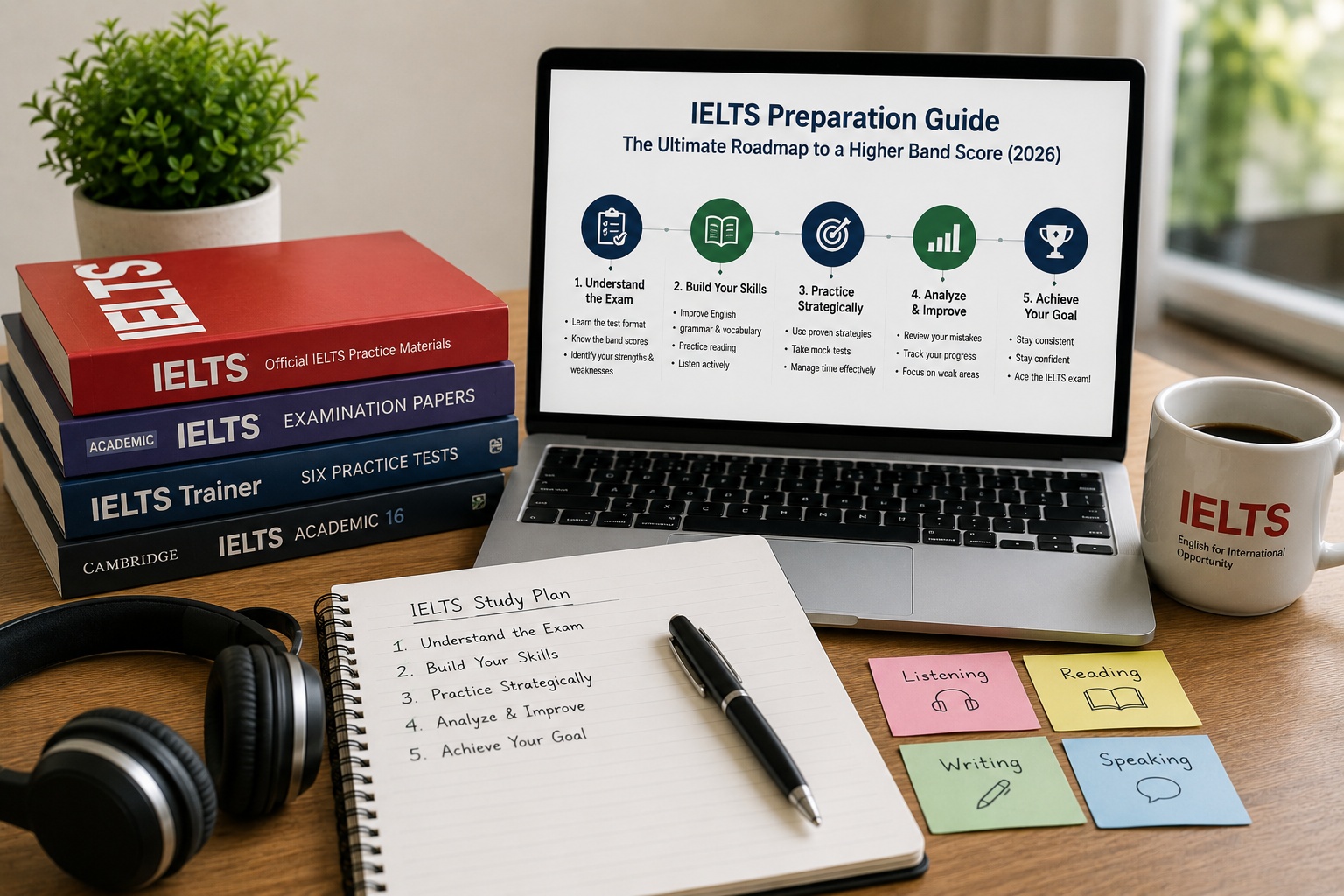
IELTS Preparation Guide: The Ultimate Roadmap to a Higher Band Score
Let’s tell ourselves the truth, the moment you decide to sit the IELTS exam, your browser history turns into a mess of tabs: band score charts, best books for IELTS forums full of conflicting advice, and at least one video promising a band 9 in just 7 days. It is overwhelming. And if you are anything like most test takers, you are not just studying English, you are studying for your future. A university seat, a visa, a job abroad. That pressure is real, and it deserves a proper plan, not scattered tips.
This IELTS preparation guide is built to cut through the noise. I will walk you through exactly what the test looks like today, how scoring actually works, how to build a study plan that fits your life, and section-by-section strategies that genuinely move the needle. No fluff, no recycled generic advice, just what works.
What Is IELTS and Why Does IELTS Preparation Matter So Much?
IELTS (International English Language Testing System) is the English proficiency test most commonly required for university admissions, skilled migration, and professional registration in English speaking countries. It measures four core skills, Listening, Reading, Writing, and Speaking and reports your ability on a 9 band scale.
Here is the thing people underestimate: IELTS is not really testing whether you know English. It is testing whether you can use English under time pressure, in specific formats, with specific question types that reward strategy as much as vocabulary. That is exactly why targeted IELTS preparation outperforms general English study every time. Two candidates with identical spoken fluency can walk out with a full band difference simply because one understood the test’s rules and the other didn’t.
Choosing Your Test: Academic vs. General Training
Before any IELTS preparation begins, you need to know which version you are actually taking, because studying the wrong one wastes real time.
IELTS Academic : required for university admissions and professional registration. Reading and Writing use academic style texts and tasks (essays, graphs, reports).
IELTS General Training : required for migration, work, and secondary education in most English-speaking countries. Reading and Writing use everyday, workplace-style texts (notices, letters, guides).
Listening and Speaking are identical across both versions, only Reading and Writing differ. If you’re unsure which one your visa or institution requires, it is worth checking the requirement directly before you commit weeks of study to the wrong module, since choosing incorrectly is one of the most common (and costly) mistakes candidates make.
The IELTS Test Format: What You’re Actually Up Against
Knowing the structure cold is half the battle. Here’s the full breakdown of the current test format:
| Section | Duration | Questions/Tasks | Key Notes |
|---|---|---|---|
| Listening | 30 minutes (+ transfer time for paper-based test) | 40 questions across 4 recordings | The Listening section is the same for both IELTS Academic and IELTS General Training. |
| Reading | 60 minutes | 40 questions across 3 passages | Academic uses journal, magazine, and newspaper texts, while General Training focuses on everyday, workplace, and practical reading materials. |
| Writing | 60 minutes | 2 tasks | Task 2 (essay) carries roughly twice the weight of Task 1 (report or letter). A common strategy is to spend about 20 minutes on Task 1 and 40 minutes on Task 2. |
| Speaking | 11–14 minutes | 3 parts | Includes an introduction and interview, a cue card long-turn task, and a two-way discussion with the examiner. |
Total test time runs just under 2 hours 45 minutes. One detail worth knowing: the IELTS band system does not work like a pass/fail grade, you receive a band score from 1 to 9 for each section, and your overall score is simply the average, rounded to the nearest 0.5. There is no penalty for wrong answers, so guessing is always better than leaving a blank.
It is also worth knowing the exam is evolving, paper based IELTS is being phased out globally, with the computer delivered version becoming the standard format. If you are booking your test, double check which delivery mode your test centre currently offers, since timing details (like Listening review time) differ slightly between the two.
Understanding the IELTS Band Score (So You Know What You’re Aiming For)
A lot of anxiety around IELTS preparation comes from not actually understanding what the numbers mean. Here is a simplified breakdown of what each band roughly represents:
| Band Score | Level | What It Means |
|---|---|---|
| 9 | Expert User | Has full operational command of English with complete fluency, accuracy, and understanding in virtually all situations. |
| 7–8 | Very Good to Good User | Communicates effectively in complex situations with only occasional inaccuracies, misunderstandings, or inappropriate usage. |
| 5.5–6.5 | Competent User | Generally communicates effectively despite occasional mistakes, misunderstandings, and limitations in unfamiliar situations. |
| 4–5 | Limited User | Has basic competence in familiar situations but struggles with more complex language and communication. |
| Below 4 | Extremely Limited to Non-User | Experiences frequent communication breakdowns and has very limited ability to use or understand English. |
If you want the full official scale, the IELTS band descriptors lay out exactly how each score maps to real-world English ability and to the CEFR framework used internationally.
Most universities ask for an overall band of 6.0–7.0, while many skilled migration pathways require 6.0–7.5 depending on the visa category. Always check your specific institution or immigration requirement rather than assuming a “safe” universal number, requirements shift, and a 0.5 band gap can mean the difference between acceptance and reapplying.
Building an IELTS Preparation Study Plan That Actually Works
Cramming does not work for IELTS the way it might for a vocabulary quiz. This test rewards consistency and pattern recognition. Here is a realistic framework depending on your timeline:
If you have 3 months:
- Weeks 1–2: Take a full diagnostic mock test to identify your baseline band in each section.
- Weeks 3–8: Dedicate focused practice to your two weakest sections, while maintaining the stronger ones.
- Weeks 9–11: Full timed mock tests weekly, reviewing every mistake in detail.
- Week 12: Light review only, rest, do not cram new material the week before.
If you have 1 month:
- Skip broad review. Go straight to targeted weak area drilling and timed practice under real exam conditions.
If you have 2 weeks:
- Focus entirely on format familiarity, timing strategy, and a couple of full mock tests. You won’t fix fundamental grammar gaps in two weeks, but you can absolutely fix time management losses.
A few non-negotiables for any timeline:
- Practice under timed conditions from day one, most band loss is not about ability, it’s about running out of time.
- Keep a single error log across all four skills so you stop repeating the same mistakes.
- Do at least one full mock test under exam-day conditions before the real thing.
- Sleep and review, don’t binge-study, in the final 48 hours.
Section-by-Section IELTS Preparation Strategies
Listening: Train Your Ears for Real Exam Traps
The recordings move fast, and the questions are designed to test whether you catch distractors moments where the speaker says one thing, then corrects themselves. Tips that actually help:
- Read the questions before the audio starts, you are listening for answers, not just meaning.
- Watch for paraphrasing, the answer rarely uses the exact word from the question.
- Practice with a variety of accents (British, Australian, North American), since real recordings mix them.
- Never leave a blank, write your best guess even if you missed the exact word.
Reading: Beat the Clock, Not Just the Text
Forty questions, sixty minutes, three passages, that is roughly 20 minutes per passage including question-answering. Most people run out of time on the last passage.
- Skim for structure first (headings, topic sentences), do not read every word linearly.
- Match question types to strategy: True/False/Not Given needs precision, matching headings needs gist understanding.
- Answer questions in passage order when possible, it saves time hunting back and forth.
Practice Not Given vs. False specifically, this is where most Reading band points are lost.
Writing: Structure Beats Fancy Vocabulary
This is the section where over preparation on vocabulary and under preparation on structure hurts candidates most. Examiners are scoring against four specific criteria: Task Achievement, Coherence and Cohesion, Lexical Resource, and Grammatical Range.
- Task 1 (Academic): Describe a graph, chart, or process objectively, no opinions, just data trends and comparisons.
- Task 1 (General Training): Write a letter (formal, semi-formal, or informal depending on the prompt) tone matters as much as content.
- Task 2 (both versions): A 250+ word essay responding to a prompt. Always plan for 3–4 minutes before writing, an essay with a clear structure and a slightly simpler vocabulary consistently outscores a disorganized one stuffed with advanced words used incorrectly.
- Practice a repeatable essay template (intro, two body paragraphs, conclusion) so structure becomes automatic under pressure.
Speaking: It is a Conversation, Not an Interrogation
Speaking anxiety is the most common complaint in IELTS preparation, and it is usually more about mindset than English ability.
- Part 1 is small talk about familiar topics relax, this is not where high scores are made or lost.
- Part 2 (the cue card) rewards structure: use the prompts on the card as a mini-outline, and don’t panic if you run slightly over or under the ideal time.
- Part 3 is where you can genuinely raise your band give developed opinions with reasons and examples instead of one-line answers.
- Record yourself practicing. It feels awkward, but hearing your own hesitations and filler words is the fastest way to eliminate them.
Common IELTS Preparation Mistakes to Avoid
- Studying English generally instead of the test specifically. Being fluent does not automatically translate to a high band if you don’t know the question formats.
- Ignoring timing during practice. Untimed practice builds false confidence.
- Memorizing model answers word for word. Examiners are trained to spot this, and it can actually hurt your Task Achievement score.
- Neglecting your strongest section. A 7 can slip to a 6 without maintenance, dragging your overall average down.
- Booking the wrong test version. Academic and General Training are not interchangeable always confirm before registering.
Choosing the Right Test Version and Resources
If you are deciding between test formats, it helps to look directly at how the two officially differ in structure. The IELTS General Training test format page is a useful reference point for comparing what each version actually expects from you, especially in Reading and Writing, before you lock in your registration.
Jobsroutedaily Conclusion
IELTS preparation is not about becoming a different, more advanced English speaker in a few weeks. It is about learning the shape of the test, its timing, its traps, its scoring logic and then applying the English you already have as efficiently as possible within that shape. Candidates who treat it like a strategic game, not just a language exam, are consistently the ones who walk out of the test centre relieved instead of rattled.
Give yourself a realistic plan, track your errors honestly, and practice under real conditions. Your band score reflects preparation as much as proficiency and preparation is entirely in your control.
Also Read 👉How to Verify Foreign Recruitment Agencies: A Proven Step-by-Step Guide (2026)
Frequently Asked Questions (FAQ)
How long should I prepare for IELTS?
Most candidates benefit from 6–12 weeks of focused preparation, though this depends heavily on your starting English level and target band. A strong starting point (upper-intermediate or above) may need less time than someone starting from a lower level.
What is a good IELTS band score?
It depends entirely on your goal. Most universities ask for 6.0–7.0 overall, while some competitive programs or visa categories require 7.5 or higher. Always check the specific requirement for your institution or immigration pathway.
Can I retake IELTS if I’m not happy with my score?
Yes. There is no limit on how many times you can retake IELTS, though each attempt requires a new registration and fee. Many candidates also use the One Skill Retake option now offered by some test centres, which allows retesting a single section instead of the full exam.
Is IELTS harder than TOEFL?
Neither is objectively harder, they test similar skills differently. IELTS includes a face-to-face Speaking test, while TOEFL uses a computer recorded format. Your choice should depend on your comfort with each format and what your target institution accepts.
How is the overall IELTS band score calculated?
Your overall band is the average of your four section scores (Listening, Reading, Writing, Speaking), rounded to the nearest 0.5. For example, scores of 6.5, 5, 7, and 6.5 average to 6.25, which rounds up to 6.5 overall.
Do I need to prepare differently for computer-delivered vs. paper-based IELTS?
Mostly the format stays the same, but timing details differ slightly computer delivered Listening gives you only a couple of minutes to review answers at the end, compared to extra transfer time on the paper-based version. It’s worth practicing in whichever format you’ll actually sit.
About the Author:
Henry Mbah, is a career and education writer with Jobsroutedaily specializing in international jobs, scholarships, visa sponsorship opportunities, and career guidance. Passionate about helping readers access reliable information to achieve their education and employment goals.