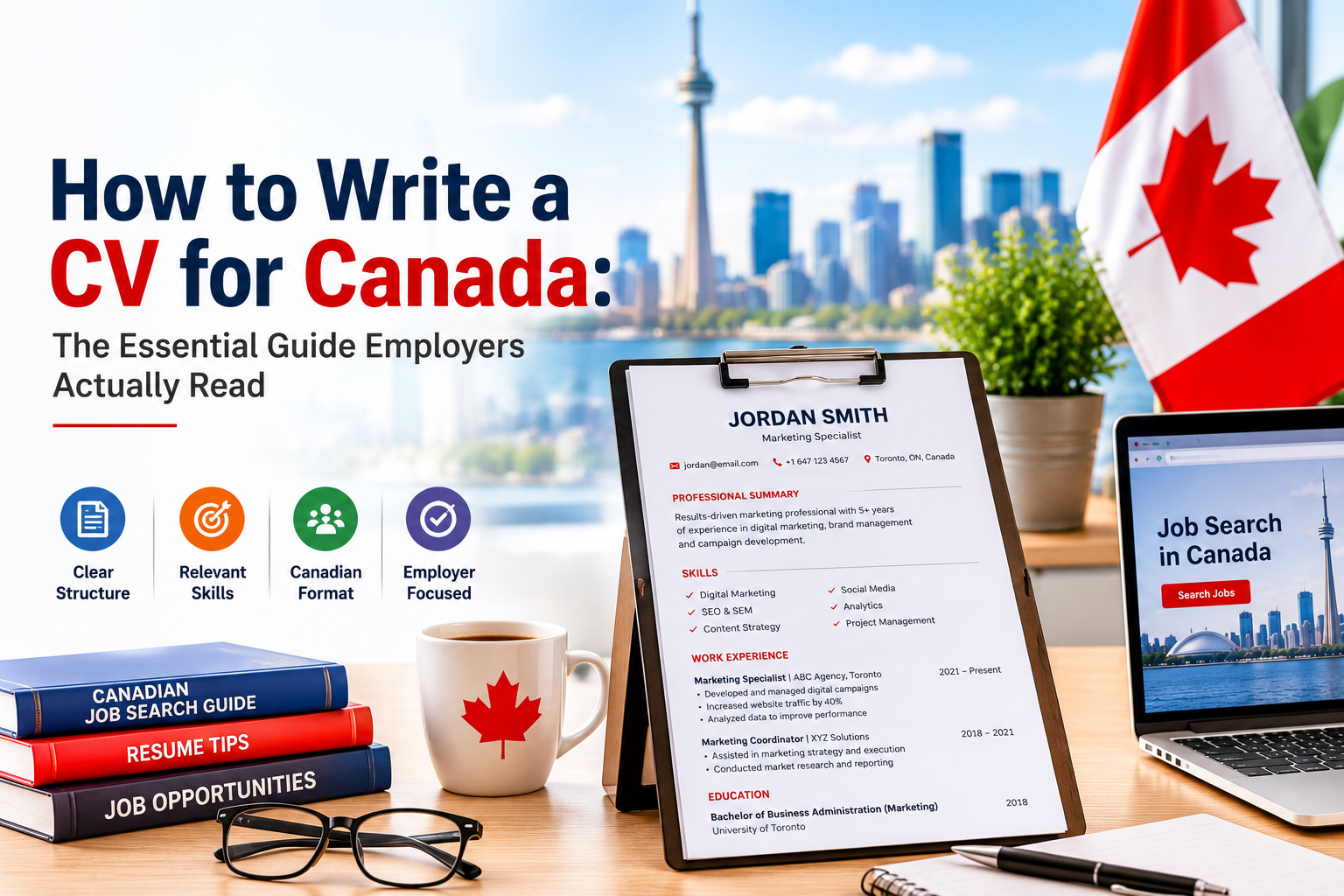
How to Write a CV for Canada That Actually Gets You Noticed
You have found the job listing and It looks perfect, right industry, right city, right salary range. You open your old CV, the one that worked back home, and start tweaking a few lines before hitting submit. A week later: silence. No callback, no rejection email, nothing.
Here is the uncomfortable truth nobody tells newcomers and job seekers early enough: a CV that works brilliantly in London, Lagos, or Manila often falls flat in Toronto or Vancouver, not because your experience is not good enough, but because the format, tone, and expectations are simply different. Learning how to build a proper CV for Canada is not a small formatting tweak it is often the single biggest factor standing between you and an interview.
In this guide, I will walks you through everything step by step, from the confusing CV vs. resume terminology mix up to the exact sections Canadian employers expect to see, so you can stop guessing and start applying with confidence.
CV for Canada vs. Resume: Clearing Up the Confusion First
Before writing a single line, you need to understand a quirk that trips up almost every newcomer. In most of the world, Europe, Asia, parts of Africa CV is simply the standard term for what North Americans call a resume. In Canada, that’s not quite the case.
As one detailed formatting guide explains, outside Quebec, a CV is different from a resume in that it’s far more detailed and reserved for academic positions or senior level research roles, while nearly all standard job postings expect a resume, typically one to two pages long. A genuine Canadian CV, by contrast, can run anywhere from two to ten pages and includes publications, research grants, and academic history.
Here is the quick breakdown:
- Resume (what most employers want): One to two pages, tailored per job, focused on relevant skills and achievements.
- CV (academic/research use only): Much longer, comprehensive, lists publications, grants, teaching experience, and conference presentations.
- Quebec exception: The terms résumé and CV are often used interchangeably there to describe the same one to two page document, so context matters.
So, when people search how to write a CV for Canada, what they usually need unless they are applying for an academic or scientific research post is actually a well built Canadian resume. That is what the rest of this guide focuses on, since it is genuinely what 95% of employers are expecting.
Why Formatting Your CV for Canada the Right Way Actually Matters
Hiring managers in Canada are not reading every CV word for word. In a competitive job market, recruiters skim resumes for just a few seconds before deciding whether to keep reading. As one career resource puts it plainly, hiring managers can receive hundreds of applications for each job opening, which means your formatting has to work fast, clean sections, obvious hierarchy, and zero clutter.
On top of that, many mid size and large Canadian companies run every application through an Applicant Tracking System (ATS) software that scans your document for keywords before a human ever sees it. If your CV for Canada is not structured cleanly with the right terms pulled from the job posting, it may never reach a person’s desk at all.
The Essential Sections Every CV for Canada Should Include
Regardless of industry, a strong Canadian-style resume generally follows the same skeleton. Here is what belongs on it, and in what order:
- Header : Full name, city and province (not your entire street address), phone number, professional email, and LinkedIn URL if you have one.
- Professional summary : A short, three-to-four-sentence pitch highlighting your experience and value, tailored to the specific role.
- Work experience : Reverse chronological order, most recent job first, with quantified achievements rather than just duties.
- Education : Institution name, credential earned, and area of study, kept brief unless you’re a recent graduate.
- Skills : A focused list matching the language used in the job posting.
- Optional extras : Certifications, languages, volunteer work, or professional affiliations, if relevant to the role.
Notice what is missing from that list: a photo, your date of birth, marital status, or nationality. That is intentional, and it matters more than people think.
Formatting Rules That Make or Break Your CV for Canada
Canadian employers have fairly specific expectations when it comes to layout, and ignoring them can make even a strong candidate look out of place. Here is what to follow:
- Keep it to one or two pages. One page suits recent graduates or early-career applicants; two pages are fine for professionals with a decade or more of experience.
- Skip the photo entirely. According to one detailed formatting breakdown, including a photo can result in immediate rejection, since Canadian anti-discrimination hiring practices lead many employers to automatically set aside resumes that include one.
- Use Canadian English spelling. Words like colour, behaviour, and labour signal familiarity with local conventions small detail, real impact.
- Choose a clean, paragraph style layout. Avoid columns or heavily designed templates unless you are applying for a design-specific role, ATS software often can not parse multi column layouts correctly.
- Use a professional, readable font. Arial, Calibri, or Times New Roman in 10–12pt size work well across most industries.
- Leave out personal identifiers. No age, marital status, nationality, or immigration status, Canadian resumes intentionally exclude anything that could enable bias in hiring.
- Skip references available upon request. It is considered outdated. Prepare a separate reference sheet instead, and share it only if asked.
Writing a Work Experience Section That Actually Sells You
This is where most CVs for Canada either shine or completely fall flat. The mistake almost everyone makes is listing job duties instead of achievements, describing what you were responsible for rather than what you actually accomplished.
As one detailed resume guide points out, the goal is to showcase how you made a unique impact in the position, not just detail the tasks you were assigned. A generic bullet like “Managed social media accounts” tells an employer almost nothing. Compare that to: “Grew social media engagement by 60% over six months through targeted content strategy” same job, completely different impression,that is it.
To strengthen this section:
- Start every bullet with a strong action verb, delivered, led, negotiated, streamlined, launched.
- Add numbers wherever possible: percentages, dollar figures, team sizes, timeframes.
- Avoid pronouns like I or my, Canadian resumes, like most North American ones, drop first person language entirely.
- Prioritize your most recent and most relevant roles, older or unrelated positions can be trimmed or summarized briefly.
- As a general rule, focus on roughly the last ten years of experience unless something older is directly relevant.
Tailoring Your CV for Canada to Each Job Posting
Sending the same generic document to every employer is one of the fastest ways to get filtered out by both humans and software. Canadian job seekers are consistently advised to customize their resume for each specific role rather than mass-applying with one static file.
One practical guide for newcomers breaks this down clearly: before writing, read the job posting carefully and pull out the required skills, qualifications, and keywords, then mirror that language in your resume wherever it genuinely applies to your background. This is not about lying or exaggerating it is about speaking the employer’s language so both the ATS and the human reader immediately see the fit.
A simple tailoring checklist:
- Highlight the top five requirements listed in the job posting and confirm your resume addresses each one.
- Mirror specific terminology from the posting (e.g., if they say client relationship management, don’t just write customer service).
- Reorder bullet points so the most relevant achievements for this specific job appear first.
- Adjust your professional summary to reflect the exact role and industry you’re targeting.
CV for Canada: Chronological vs. Functional Format
Choosing the right structure depends heavily on your work history and how much of it directly applies to the role you want. Here is a side-by-side comparison to help you decide which fits your situation.
| Format Type | Best For | Structure Focus | Watch Out For |
|---|---|---|---|
| Chronological Resume | Applicants with a strong, relevant work history | Lists work experience in reverse chronological order, highlighting career progression and recent accomplishments. | May draw attention to employment gaps or frequent job changes if not addressed appropriately. |
| Functional (Skills-Based) Resume | Career changers, recent graduates, newcomers, or applicants with limited local experience | Emphasizes skills, qualifications, and achievements before providing a brief employment history. | Some employers may view this format with caution if it appears to hide a weak work history. |
| Hybrid (Combination) Resume | Professionals with transferable skills and varied experience | Combines a skills summary with a concise reverse chronological work history. | Requires careful organization to avoid appearing overly long or cluttered. |
For most applicants, especially newcomers translating international experience into a Canadian context the hybrid format tends to strike the best balance between showcasing transferable skills and giving employers the reassurance of a clear career timeline.
Common Mistakes That Sink an Otherwise Strong CV for Canada
Even candidates with excellent qualifications sabotage their own applications with small, avoidable errors. Watch for these:
- Sending a one size fits all resume to every job instead of tailoring it per posting.
- Listing responsibilities instead of results, leaving hiring managers with no sense of your actual impact.
- Including irrelevant personal details like a photo, age, or marital status, which can raise red flags rather than build trust.
- Ignoring date formatting conventions, Canadian resumes typically favor the ISO format (YYYY-MM-DD) or clearly written month-year combinations, avoiding ambiguous numeric-only dates.
- Overloading the document with dense paragraphs instead of clean, skimmable bullet points.
- Forgetting to proofread for Canadian spelling a resume full of American spelling variants can be a subtle but real inconsistency in the eyes of a local recruiter.
Should You Include a Cover Letter With Your CV for Canada?
My answer is yes, whenever possible. While not every Canadian job posting explicitly requires one, a well written cover letter gives you room to explain career transitions, relocation circumstances, or specific enthusiasm for the company that a resume format simply doesn’t allow for. It is a small extra effort that often makes a noticeably strong impression, especially for newcomers whose international experience might need a little context.
Jobsroutedaily Final Thoughts on Writing Your CV for Canada
At its core, a strong CV for Canada is not about reinventing your entire career on paper, it is about translating what you have already done into a format that Canadian employers recognize, trust, and can scan quickly. Keep it concise, quantify your achievements, tailor it to each posting, and strip out anything that isn’t directly relevant to the job at hand.
The applicants who land interviews are not necessarily the most qualified people applying, they are often just the ones whose resume made that qualification instantly obvious in the first ten seconds of a hiring manager’s glance. Put in the work upfront, and that ten-second glance becomes your best advertisement.
Also Read 👉Nursing Assistant Jobs With Visa Sponsorship: The Real 2026 Guide (No Fluff)
FAQ: How to Write a CV for Canada
Is a CV the same as a resume in Canada?
Outside Quebec, no. A Canadian CV is a lengthy, detailed document used almost exclusively for academic or research positions, while a resume, one to two pages is what most employers expect for standard job applications.
How long should a CV for Canada be?
For most job applications, one page suits recent graduates or early career candidates, while two pages work well for professionals with significant experience. Academic CVs are the exception and can run much longer.
Should I include a photo on my Canadian resume?
No. Canadian employers generally avoid resumes with photos to prevent any appearance of hiring bias, and including one can lead to your application being set aside entirely.
What date format should I use on a Canadian resume?
Many Canadian resumes use the ISO date format (YYYY-MM-DD) or clearly spelled out month year formats to avoid ambiguity, since numeric date formats vary by region.
Do I need a different resume for every job I apply to?
Yes, ideally. Tailoring your resume to match each job posting’s specific language and requirements significantly improves your chances of passing both ATS software and a human reviewer’s first scan.
Should newcomers to Canada use a functional or chronological resume?
It depends on your background. A functional or hybrid format often works best for newcomers translating international experience, since it emphasizes transferable skills before diving into a full work history timeline.
About the Author:
Henry Mbah, is a career and education writer at jobsroutedaily, specializing in international jobs, scholarships, visa sponsorship opportunities, and career guidance. Passionate about helping readers access reliable information to achieve their education and employment goals.